Sunday, November 1, 2009

Why do good people die?

It seemed a good idea a couple of weeks ago when I put my plans for today’s service together. I did it a week in advance because we were going away.

I looked at the calendar and today has an appropriateness for addressing this particular question.

Yesterday was all hallows eve – Halloween – and great to have a Light Party for the children, not to mention our wonderful Come and Sing Messiah!

That makes today, 1st November, All Hallows day, or as it is better known nowadays, All Saints Day. I have to confess it is not a day I mark in the Christian Calendar. But this year it seemed a good idea.

At least, it seemed a good idea then, a fortnight ago … I am not so sure now. After all, it really is one of those big questions that people struggle with, and if I am honest it is a big question I have struggled with too.

Why do good people die?

It’s funny, isn’t it. One thing that we all have in common, one thing we all know will happen, is death. And yet death is one thing that remains something of a taboo subject. It’s not good to talk about it too much, and so we avoid it, talk around it, evade the issue.

And then something untimely happens, something out of the blue, and it happens to the person it should not happen to. Out of time, and in a way that’s just wrong … someone dies. And you feel they shouldn’t have died.

It was lovely returning to Shropshire and visiting the churches we belonged to before moving down here to Cheltenham. It was the first time we had been back just for fun. We had been back to take services a couple of times; we had been back for funerals on two occasions. It was great going back as a family and going to both churches last Sunday morning as a family. It was great going up into the Shropshire hills. Wild and rugged in the wind on the Saturday and Sunday, at their most beautiful in the sun on the Monday. It was great to bump into a family on the Monday afternoon on the top of the hill everyone who lives in Pontesbury thinks of as our hill. Earl’s hill. It felt as if we were at home.

On our first morning we went into Shrewsbury on the Park and Ride, and got talking to a fellow-passenger waiting for the bus, as you do. I felt catapulted right back into the world we were in for those eight years. In the space of five minutes the lady we spoke to spoke of her sadness at the loss of her daughter in a car crash, the loss of her husband at a young age … and the culling of all the livestock on their farm.

It was only a chance conversation at the bus stop.

Her daughter was a good girl, her husband a good farmer, her livestock good cattle

Why, why, why do good people die.

In those eight years it was a question I found myself asking time and again. The countryside is not the idyllic place townspeople imagine: it has its darker side too, not least in loneliness and depression. In those eight years I became involved with more families who had lost a loved one through suicide than in all the rest of my life put together. And they were all ‘good people’. Why do good people die?

I became involved with more families who had lost a loved one in a road accident that in all the rest of my life put together. And they were all ‘good people’. Why do good people die?

People lost it tragically … and losing it went for the gun in the corner of the room – the deaths that followed were deaths that prompted the awful question again, Why do good people die?

We were given a wonderful book that had been published for the millennium – a big, glossy publication. The churches and chapels of Pontesbury Parish. And there was the story of our chapel. And there was a potted biography of me as minister! It was during our time there that we developed a healing ministry.

No sooner was that under way in a wonderful partnership with our GP who was also our Church Secretary, but the awful happened. Ian’s wife, Beryl, was diagnosed with an inoperable cancer and within six months had died.

Unquestionably, a good person.

Why do good people die?

Just before we moved to Shropshire my father died while still in hospital after receiving surgery that we thought would make him better and enable him to enjoy the retirement that had only just begun.

Just after we left Shropshire my mother died when as a pedestrian she was knocked over by someone doing 40 mph within a 30 mph speed limit.

An untimely death and an unnecessary death of two good people … why do good people die?

Let me say straightaway.

I do not have an answer.

Let me offer three reflections and one response..

First, there is no escaping the question: better to let it out in rage than to bottle it up. I find great comfort in the knowledge that even people of the deepest faith find this a troubling question.

Psalm 13 has long been a favourite of mine. It is the cry of despair of one who has asked this question so many times and still hasn’t had a response from God …

How long, O Lord, Will you forget me forever?

How long will you hide your face from me?

Psalm 22 begins with that sense of being forsaken of God that Jesus experiences on the cross, “My God, my God why have you forsaken me?’

Within prayer there is space for rage at God. The question must not be bottled up.

When our church secretary and GP’s wife died, Ian Bradley told the story of the experiences he and Beryl had shared from the time they first knew something was wrong to the time of her death and shared it in some very moving Bible studies and in a moving booklet.

Ian did not find it helpful to try to work out an understanding of God that would explain the question. In fact he warns against trying to mould an understanding of God that answers such questions.

Ian speaks movingly of the way both he and Beryl found it helpful to focus beyond themselves on God as he is, as they had discovered him in the Bible, through the church, in hymns that had been their favourites in the faith that had been passed on to him.

Ian draws a distinction between a prayer of thanksgiving in which you give thanks for things that have happened, for gifts of God and blessings, and a prayer of praise in which you focus on God in his reality, in his mystery and above all in his love. He and Beryl valued the power of praise to take you out of yourself and to focus you on the reality of God, in all his mystery and in all his love.

The Psalmist does not move in either of those psalms to an understanding of God, but rather to praise of God in spite of the circumstances he finds himself in.

After four bleak verses of Psalm 13 the Psalmist finds no answer to his questions, but puts his trust in God …

But I trusted in your steadfast love;

My heart shall rejoice in your salvation.

I will sing to the Lord,

Because he has dealt bountifully with me.

This whole issue is taken up in the book of Job. Job is a good man who encounters untold suffering. And this begs the question Why?

Friends come with explanations that try to mould an understanding of God that will account for the untold suffering and loss that Job experiences. None satisfies Job. No answer can encapsulate God.


Job then finds himself in the open confronted by the grandeur and majesty of God, and senses that God is greater and far beyond all that is happening to him. The book comes to an end with Job finding no answer, but coming to live with unanswered questions.

My first reflection then is to focus on the reality of God. This is exactly where Jesus begins in that passage from John 14 that we read earlier. Let not your hearts be troubled, he says to his close friends at the Last Supper on the night in which he was betrayed, the night before he was to be crucified. It was as if he was preparing his friends for the following day when they would find themselves asking precisely this question of Jesus, Why do good people die? Why has this good person died?

Let not your hearts be troubled. Believe in God.

This is the first thing to hold on to. Faith in God. It’s not helpful to try to work out some kind of ‘theology of God’ that answers all those raging questions. Instead hold on to believing in the God that has been revealed in Bible in favourite hymns, through the church down through the ages. Keep on believing in God.

But that is easier said than done.

And so I want to move on to the second of my reflections.

Ian called the little booklet he wrote ‘A Journey with Jesus’. He speaks movingly of the way he and Beryl felt they were not alone in the often frightening journey they had to make.

In John 14 Jesus goes on to say,

Do not let your hearts be troubled.

Believe in God, believe also in me.

In my Father’s house there are many dwelling places.

If it were not so, would I have told you that I go to prepare a place for you?

And if I go and prepare a place for you,

I will come again and will take you to myself.

On the way to the car-park to climb Earl’s Hill we passed a cottage where one of our older members had lived. I well remember visiting her in hospital, when we thought she was dying. Indeed it seemed that she had died. But she pulled through … and subsequently spoke of that sense of walking down a long passageway, a tunnel with a sense of not being alone, but with light drawing her on.

That stuck with me. It meant a lot to Ian and Beryl. The journey to death and what is beyond is a journey we do not make on our own. Friends and family can accompany us so far on the way. But there comes a point when we have to go further. At that point Jesus is with us alongside us accompanying us, leading us home.

I will come again and take you to myself,

so that where I am there you may be also.

The second reflection, then, is that we must hold on not just to believing in God, but to believing in Jesus as the One who comes alongside us and journeys with us through the darkest of times.

And the third reflection again echoes thoughts Ian shared in that booklet.

Ian went on to speak of the importance of that unseen, yet very real presence and strength of God in Christ that is given us in the unseen power of God that is the Holy Spirit. Jesus says in this chapter,

I will not leave you orphaned. I will not leave you all on your own.

I will ask the Father, and he will give you another Comforter, a strength alongside you, an Advocate, A counsellor, to be with you for ever. This is the Spirit of truth who abides with you and will be in you.

Living with unanswered questions …

  1. let’s hold on to our believing in God,
  2. let’s recognise we are not alone, we have the presence of Christ with us on the journey
  3. and we have the unseen yet very real strength of the Spirit of God around us and within.

Why do good people die?

The church does not have an answer.

The church does have a response.

We can point people to the reality of God, the God who comes alongside us and walks the journey of life at its worst with us in Jesus Christ, who offers us a strength from beyond ourselves in the unseen, yet very real power of the Holy Spirit.

The response we make is even more important.

For Ian and Beryl it was important that they were not alone. They were part of a Church fellowship.

He writes, “So much of what we received from God could only have been received because we were part of a Christian fellowship – the body of Christ on earth.

“God’s love came to us through the labours of those who baked cakes, dug our garden, tidied the house, and did so many other things. We were not relying on some abstract concept of God’s love, but were experiencing it in a very real and practical way. It was in that atmosphere we were able to know the full joy and peace of God.”

The question remains.

The answer is elusive.

But the response we make makes a world of difference.

Fundamental to our response to this question is not just the faith we share and celebrate this All Saints Day, but also the love we embody through all the pastoral care we share as a church that seeks to be the body of Christ on earth in this place.

How good that this All Saints Day we celebrate our visiting scheme by saying thank you to Joan and Olga for all they have done in co-ordinating our visiting network, and to Phil and Joyce, David and Betty for all the work they are doing, together with all our church visitors and all the church family.

We can become the response to a question that has no answer.

Sunday, October 18, 2009

Asking big questions - on forgiveness

If you haven’t already, do make a note of the question you’ve always wanted to ask but never had the opportunity to.

As you can imagine the questions that appeared at the end of last Sunday’s service are pretty big questions.

It is the way that reading of the opening words of the Sermon on the Mount ends that prompts the first of those big questions.

In the Sermon on the Mount Jesus says, “Happy are you when people insult you, persecute you and tell evil lies against you”

How can we learn to be able to forgive people when they do it to us personally? Not easy.

A big question indeed! And one I hesitate to respond to. I am not willing to tell anyone how to forgive. If forgiveness is important it is one of those things we each have to learn, discover, receive, grow into in our own time, in our own way. And I fear it is something we none of us can do in our own strength, but only in the strength that God gives.

Having said that, I do want to respond to the question.

First of all, I want to make a categorical response. A clear response. A definite response.

The questioner starts with a statement from which the question follows.

In the Sermon on the Mount Jesus says, “Happy are you when people insult you, persecute you and tell evil lies against you.” The questioner then goes on to ask, “How can we learn to be able to forgive people when when they do it to us personally.”

In response, I first want to ask whether Jesus does say that in the Sermon on the Mount. Look again at Matthew 5:11 and 12

Happy are you when people insult you and persecute you and tell all kinds of evil lies against you because you are my followers. Be happy and glad, for a great reward is kept for you in heaven. This is how the prophets who lived before you were persecuted.

This is my categorical response.

Jesus is NOT talking about people who insult you, persecute you and tell evil lies against you at a personal level, in a personal kind of way.

Having outlined the eight general principles of the Beatitudes Jesus now turns directly to those who have decided to follow him and he gives them words of encouragement they are to hold on to when they come up against people who insult them, persecute them tell all kinds of evil lies against them BECAUSE THEY ARE FOLLOWERS OF JESUS.

These words have nothing to do with personal abuse, violent behaviour.

These words are about the persecution of Christians because of their Christian faith.

Contrary to the view of the little girl in Outnumbered who was echoing the words of a hymn, the Jesus of the Gospels, the Jesus at the heart of our Christian faith, is not meek and mild.

He is outspoken in his condemnation of those who are abusive and violent.

At the end of Matthew’s gospel Jesus speaks in no uncertain terms condemning those who are the perpetrators of falsehood, the lie and such evil behaviour. Woe betide you he says, not once, but seven times.

These words in the Sermon on the Mount have nothing to do with lies, abusive behaviour, bullying at a personal level.

Faced with such a situation Jesus would and did condemn outright the perpetrator of such violent, abusive destructive, bullying behaviour. He would respond and did respond to the victim of such behaviour by bringing healing to the damage that had been done.

That did not always involve bringing people together – it is easy to forget that Jesus also recognised there were circumstances in relationships where such damage had been done that it demanded separation of the people involved, and in the instance of it happening within a marriage, divorce.

The first part of my response to this difficult question is to say quite categorically those words of Jesus in the Sermon on the Mount are not about personal insults and abusive behaviour.

So where does forgiveness come in?

There can be no escaping the centrality of Forgiveness for the Christian.

Forgive us our trespasses

As we forgive those who trespass against us

It is very easy to link ‘forgiveness’ with the restoration of a broken relationship. Sometimes the link can be made. Someone does something wrong, shows remorse, is forgiven and a relationship is restored.

But that link cannot always be made. When remorse is not shown, when relationships are broken irretrievably what about forgiveness then? Is it something that is inappropriate? Or is it still something of value?

I wonder whether there is a value in forgiveness for the individual quite aside from anything to do with the restoration of a broken relationship.

I wonder whether Jesus makes so much of the importance of forgiveness because he recognises that inside the individual who is a victim this thing ‘forgiveness’ can actually become part of a healing process for them as a victim.

It is in this context that I want to return to the question.

How can we learn to be able to forgive people when they do it to us personally? Not easy.

Let me share two stories.

At our Ministers conference this year we hosted an exhibition and welcomed someone whose inspiration the exhibition was. The exhibition was simply called ‘The Forgiveness Project’. Our speaker was Jo Berry. Jo Berry’s father was a Conservative MP who was killed in the Brighton Bombing 25 years ago last Tuesday.

She sat quietly and simply shared her story. It was deeply moving and humbling to listen as she spoke of the scale of the impact of what had happened. She spoke of the long long years of hatred, questioning, despair, that had led her to the quest for empathy, understanding … and the recognition of the importance of forgiveness.


Jo Berry's Story on the Forgiveness Project Web site


Roy Jenkins interviews Jo Berry and Patrick Magee on All things considered for BBC Wales.


To some, Lord Tebbitt included, who was so severely injured and whose wife was paralysed as a result of that bombing it was deeply offensive for the House of Commons Committee on Conflict to host The Forgiveness Project and its exhibition and to invite Jo Berry, a victim, and Patrick Magee who had planted the bomb to speak together on the same platform.

Harvey Thomas was interviewed by Ed Stourton on the Sunday Programme last week about the planned event and the importance to him of forgiveness. This is what he said …


An interview with Harvey Thomas.


See the report on the BBC News of this interview and the Forgiveness Project.

Two observations on that story. Harvey Thomas only speaks for himself. In the interview as originally broadcast he went on to speak movingly and supportively and with understanding of Sir Norman Tebbit who considered that meeting inappropriate and called in question the whole purpose of ‘the forgiveness project’.

A second observation. It took Harvey Thomas 12 years before he made the contact he felt was necessary. 12 years. A long time. It took Jo Berry more than 20 years and still she speaks of empathy, understanding, and not so much of ‘forgiveness’.

How do we learn forgiveness? I am not sure it is something to be learned. It is something to be reminded of. That’s why it is good to say the Lord’s Prayer. It is good to come around the table in communion and constantly be reminded of the forgiveness that we are on the receiving end of from God in the wonderful love of Christ, and then to be reminded of the forgiveness that can come in our heart.

We cannot learn forgiveness, we can be reminded of it. And as we are reminded of it, maybe it will creep up on us unexpectedly, in time the kind of forgiveness that can heal up our own wounds can come.

And such forgiveness can be healing.

Another story from the Forgiveness Project web site.

Francis & Berthe Climbié (England)

Victoria Climbié’s life was short and tragic. Born in the Ivory coast, at the age of seven her parents, Francis and Berthe Climbié , trusted her into the care of a relative, Marie-Therese Kouao, who brought her to England to be educated. It was here that she met her death – tortured and killed by the very person who had promised to help her.

Initially, when we first heard about Victoria we could not forgive. We are human beings and no human being is perfect. We were tormented by guilt, anguish and hatred, and could not understand how our daughter’s life could have been destroyed by someone who had promised to take care of her. Victoria was very, very precious to us. We had so many expectations and so much hope for our child. Even so, from the very first day we heard about the death of Victoria, we began praying that one day we would be able to forgive.

If you want to live happily and at ease in this life you have to learn to forgive. It shouldn’t matter if the person is unable to ask for forgiveness or even acknowledge that they’ve done wrong, because forgiveness cannot be based on conditions. So we’re not waiting for Marie-Therese to ask for our forgiveness: whether she asks for it or not we have forgiven her. But while Marie-Therese has shown no remorse, her boyfriend, Carl Manning, did ask for our forgiveness. The sad thing is he hasn’t achieved freedom – not in his body, his mind or his soul. We can’t ignore their culpability. Whatever wrong people do in life there will be a price to pay, but it is not for us to punish. The legal system has its way of dealing with people who are not fit to live among humans.

We have also been able to forgive all those agencies and individuals who were shown through the public inquiry to have failed our daughter. To be locked into a fixed attitude of retribution is to kill a child twice. First, the child is murdered, but if you as the parent then focus only on retribution, you extinguish the very spirit and memory of your child.

Many people in England have asked us why we gave Victoria away. I want to say that we didn’t give her away. In African society children are not just the children of their parents, but the children of their aunts and uncles, grandmothers and grandfathers, brothers and sisters. The greatest privilege of all is for a relative to offer to educate your child abroad. In Africa we are only able to survive because those who are successful feel a duty to help those who are not.

What comfort is revenge? Our greatest desire is that something positive should come out of this tragedy. That’s why we’re opening a school in the Ivory Coast. It will be a centre of excellence providing education for children from all around the world. The sole reason for Victoria coming to England was to get an education. This school is our way of immortalising the spirit and the name of our child.

Let’s keep saying the Lord’s Prayer. Let’s keep remembering the body of Christ broken for us the blood of Christ shed for the forgiveness of sins.

Let’s keep reminding ourselves of this thing called ‘forgiveness’ that Jesus shared with us and was convinced could make such a difference inside our own hearts.

How long do we go on reminding ourselves of this forgiveness? Seven times? Or seventy-times-seven times? It may take a life-time and maybe even more. It is not easy.

Sunday, October 11, 2009

Listening and Asking Questions

The questions children ask are not always easy to answer.

Questions to the vicar – a clip from Outnumbered.

The questions the six year old asks will have changed by the time he reaches the age of 12.

But questions will still be there.

When Jesus was 12 years old he went missing in Jerusalem as his family returned from their celebration of the Passover. In a panic his parents search for him …

After three days they found him in the temple, sitting among the teachers, listening to them and asking questions.

That was something Jesus continued to do on into his adult life.

He was good at listening and asking questions.

What do you expect from the questions you ask?

The five year old expects an answer – clear, black and white, cut and dried, simple answer.

I suspect the twelve year old will not only ask different questions but also be prepared for different answers.

And the adult? Do we expect the questions we ask to have simple, black and white, cut and dried, straightforward answers?

Not only do we find Jesus time and again listening and asking questions, we also find in the gospels people coming to Jesus and asking questions of him.

What kind of answers do they expect?

If they were expecting those simple cut and dried answers, they were in for a disappointment.

Someone has calculated that of the 183 questions Jesus is asked in the four gospels he only gives a simple straightforward answer to three of them.

Is it that he avoids answering in a simple way? Or is it possible that the responses he gives to the questions he is asked are doing something different?

Richard Rohr is one of those thinkers I feel drawn to. A Franciscan he set up The Centre for Action and Contemplation in Albuquerque, New Mexico, back in 1987. He passionately believes that Christians should make a difference in the world through social care and the service of others. Equally passionately he believes that we can be sustained in that task only by prayer and reflection – the Centre for Action and Contemplation is ‘a place to be still and learn how to integrate a contemplative lifestyle with compassionate service. The Centre’s purposer would b e to serve not only as a forum for peaceful, non-violent social change but also as a radical voice for renewal and encouragement.” [http://www.cacradicalgrace.org/aboutus/aboutus_index.html]

Felicity and I were talking through with Becky, Lrraine and with Mark Evans this week what we are looking for from our weekend away at Brunel Manor. We sensed that there is a business at Highbury that is great – it’s what church should be about. Great to see the mix of groups meeting and the range of activities we are doing.

Having a church weekend away is not something to add to that business. That weekend Mark and Denise will join us for will be an opportunity to get away together, and find the space for ‘renewal and encouragement’.

In the foreword to what looks an intriguing book with the title ‘The Questions of Jesus’, Richard Rohr reflects on what we expect from the questions we ask. “In the realm of soul and spirit,” he suggests, “there are not really answers as much as there are answering persons.”

Those really deep questions that are so important to share are not about the quest for cut and dried answers; instead their purpose is in Richard Rohr’s words, ‘to lead one into a vital relationship.”

So often people expect ‘religion’ to resolve their dilemmas and give straight answers.

Jesus works very differently.

Asked by Pilate “Where are you from?” Jesus gave him no answer (John 19:9)

Asked by the Herodians who were among those Jewish people who collaborated with the Roman occupation and the Roman power, “Is it lawful to pay taxes to the emperor or not?” he answered with another question, taking a Roman coin, “Whose head is this and whose inscription?” (Matthew 22:20)

Asked by a certain lawyer, Who is my neighbour? Jesus did not give a straightforward answer. Instead, he told a story, the wonderful story of the Good Samaritan. (Luke 10:25-37)

Let’s take one episode in Mark’s Gospel.

17 As he was setting out on a journey, a man ran up and knelt before him, and asked him, ‘Good Teacher, what must I do to inherit eternal life?’

Let’s get the question straight in our minds. So often people mistake the meaning of this question and imagine it to be asking, What must I do to get to heaven?

Listen to the question. What must I do to inherit something … you inherit something from someone who has died while you are still alive. The question is the key one to this Jewish young man … what must I do to inherit from all those who have gone before us who have belonged to the people of God and have shared this remarkable faith of ours, what must I do to inherit that life that begins here and now is shot through with the glory of God’s presence and is not bounded by death? Good teacher, what must I do to inherit eternal life?

18Jesus said to him, ‘Why do you call me good? No one is good but God alone.

No immediate answer. But a question in response. Is it a clever put down? Or is it actually straightaway pointing this person back to God. It is Jesus the man at this point directing the young man to the goodness of God. Any questions about eternal life have to do with the goodness of God.

Then Jesus continues. Again, listen carefully.

19You know the commandments: “You shall not murder; You shall not commit adultery; You shall not steal; You shall not bear false witness; You shall not defraud; Honour your father and mother.”

Were you listening carefully?

Who knows their ten commandments?

Are these the commandments?

Or has Jesus slipped something in?

Six of them are the six commandments that have to do with our behaviour. The other four are to do with God.

But there are seven in this list.

The one Jesus has slipped in is in keeping with all the others.

Do not defraud.

Why has Jesus slipped that in?

Could it be that the wealth of this young man has been accumulated on the back of fraud?

20He said to him, ‘Teacher, I have kept all these since my youth.’

What happens next as this conversation unfolds we must not gloss over. Richard Rohr suggests it is one of the most moving of all moments in the whole gospel story.

21Jesus, looking at him, loved him

Was it that look that went behind all the façade, knew him as he was, with all his blemishes, maybe all the blemishes he wanted so carefully to conceal?

That look that loved in spite of knowing so much?

21Jesus, looking at him, loved him and said, ‘You lack one thing; go, sell what you own, and give the money* to the poor, and you will have treasure in heaven; then come, follow me.’

A general principle? For this young man it cut through to the bone.

22When he heard this, he was shocked and went away grieving, for he had many possessions.

This young man does not instantly follow Jesus. Neither does he go away having rejected everything. He goes away in very deep thought. Grieving.

But that is not the end of the story. What follows on does not offer those who have been listening in to the story a simple, straightforward answer that is applicable to everyone. Jesus conversation has the effect of making them think. Track it right through and it leads to another question.

23 Then Jesus looked around and said to his disciples, ‘How hard it will be for those who have wealth to enter the kingdom of God!’ 24And the disciples were perplexed at these words. But Jesus said to them again, ‘Children, how hard it is* to enter the kingdom of God! 25It is easier for a camel to go through the eye of a needle than for someone who is rich to enter the kingdom of God.’ 26They were greatly astounded and said to one another,* ‘Then who can be saved?’

The response Jesus gives is not a simple, clear cut answer.

It is a response that makes them think even more deeply.

27Jesus looked at them and said, ‘For mortals it is impossible, but not for God; for God all things are possible.’

The conversation started with the goodness of God. It finishes with the conviction that for God all things are possible.

And we are left looking in on the conversation Jesus had with the man, the conversation he had with the disciples. And we are left to draw our own conclusions. We are left asking more questions … but these are questions that have the potential to draw us more closely into a relationship with others who are grappling with the same problems, more closely into a relationship with God, and more closely into the way Jesus invites us to follow when he invites us to follow him.

How good it is to ask questions! That’s exactly what Becky and I would like to invite you to do. With the Order of Service paper is another sheet. It is for you to write down those questions you have always wanted to put in church but never had the opportunity to ask!

How good it is to ask questions! Can we move on from the quest for simple answers? Can we engage with answering persons? Can we see the process of asking questions as the way into a more vital relationship with God? Can our questions enable us follow the One who loved to listen and to ask questions?

Read Richard Rohr's Forward to John Deare's Book, The Questions of Jesus

Sunday, September 27, 2009

Bear one another's burdens

Maybe it’s because on my mother’s side I come from a family of teachers, maybe it’s because between myself and my children 37 years of my life have been determined by the school year, I always think of September as marking the start of a new year.

It works for me as a Christian as well. Maybe it’s no coincidence that the Jewish New Year falls in September. In September we celebrate the wonder of God in creation – with marvellous displays of flowers, vegetables, fruit – the fruitfulness of God’s creation!

Then at Christmas we celebrate the way God comes into our lives through Jesus Christ – born as one of us, he lived among us and mapped out for us the way to live a fully human life.

In Holy Week and Easter – we mark his death and resurrection and marvel at the extent of his forgiving love and the share we have in his resurrection victory.

And then as summer arrives it’s Pentecost and we mark the outpouring of the Holy Spirit, the energising power of God with us.

One passage seems to me to bring all of that together. It’s a passage that speaks of fruit – and brings to mind the beauty we see around us today. It speaks of the the things that characterise a Christian life and brings to mind all that Jesus taught, and it brings to mind the energising power of the Spirit that comes at the climax to the year.

Paul talks of fruit and imagines all manner of wonderful fruit. He then suggests that the very things that characterise a Christian life, love, joy, peace patience, are not so much things we generate in our own strength, but are rather the fruit of the energizing power of that unseen force of God’s presence with us in the Holy Spirit.

He speaks of the fruit of the Spirit … and then he finishes in this passage with a one liner that sums up all that Jesus’ teaching stands for.

Galatians 5:22 to 6:2

the fruit of the Spirit is love, joy, peace, patience, kindness, generosity, faithfulness, gentleness, and self-control. There is no law against such things. And those who belong to Christ Jesus have crucified the flesh with its passions and desires. If we live by the Spirit, let us also be guided by the Spirit. Let us not become conceited, competing against one another, envying one another.

My friends, if anyone is detected in a transgression, you who have received the Spirit should restore such a one in a spirit of gentleness. Take care that you yourselves are not tempted. Bear one another’s burdens, and in this way you will fulfil the law of Christ.

It is the one line liner I want to home in on.


Bear one another’s burdens, and in this way you will fulfil the law of Christ.

That’s what Jesus stands for in a nutshell.

We each have burdens to bear. Instead of going it alone, we need to be prepared to carry each others’ burdens.

It was this verse that inspired the Christian social reformers in the second half of the nineteenth century to find a better way of providing care and support in a safe haven or ‘asylum’ for people with mental health problems. The inscription they put over the door of what became the Coney Hill hospital remained there until the hospital’s closure in 1994.


Their vision was that people with mental illnesses should live in a setting where people would look out for each other, care for one another, and carry each others’ burdens.

We have moved on from those big institutions. But now as people with mental health problems are in the community, the community as a whole needs to be a place where people look out for each other, care for one another and carry each others’ burdens.

That in a very real sense is what church is about. Be it in our network of prayer, in our pastoral care visiting scheme, or indeed in our hosting many community groups church at a local level needs to be a place where we look out for one another, care for another and carry each others’ burdens.


But church must not be an inward looking place where we look out only for each others’ needs. It needs to be an outward looking place where we extend that wonderful vision into the wider community.

That’s what our Alpha Course is about – people do ask those big questions that at times seem so imponderable. Who? Why? What? How? What is the point of Life? Why do people suffer? What happens when we die? Is forgiveness possible? To have space to think through some of those questions and share with one another the place to begin to find some of the answers. Tuesdays at 7-00 from 6th October.


Each month we support a local charity. Next month it will be the Cotswold Downs Group, friends of Daniella, that Bob and Nia helped to found. This month it has been the County Community Projects. Each week we invite people to bring gifts of packaged food to support the food parcels CCP puts together and for harvest today a special invitation – in so many ways, CCP is helping children, young people, families and vulnerable adults reach their full potential in life.


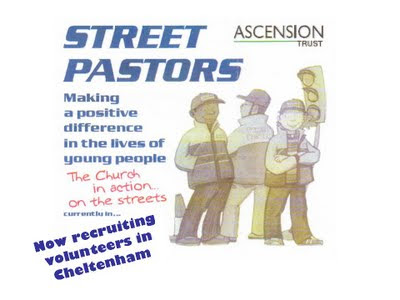
The Street Pastors initiative going is very much about churches taking action on the streets, helping to meet the needs there are in the town centre streets at night times over the weekend – more information about the need for volunteers is in the current Highbury News – in particular applications are invited to do the work of Street Pastor on the streets.


Caring for another, looking out for each other, carrying each others’ burdens doesn’t stop at our own locality. To be part of one local church is to be part of the world-wide church. Through our Congregational Federation we have entered into a partnership with the Oné Respé project that brings Honour and Respect to the streets of the Dominican Republic.


This small scale project is working with 125 young people in weekly youth meetings, 80 men in ‘new masculinity’ meetings, addressing among other things domestic violence – with the slogan on the tee shirt Juan Pedro Linares is wearing, ‘for a society without machismo’.

100 women in weekly meetings, 140 community health promoters, and a number of schools.

And as in so many island nations, Oné Respé shares with the Christian Aid focus not just on campaigning for climate change but pledging to do something about it in the countdown to Copenhagen.

Looking out for one another, caring for another, carrying one another’s burdens.

It can take it out of you!

Carrying one another’s burdens can become a burden in itself – it is wearing simply to begin to think of the burdens of responsibility placed on us.

The wonderful insight our Christian faith has is that when we seek to carry one another’s burdens and so fulfil the teaching of Christ, we are not on our own.

The very Jesus Christ whose teaching is summed up in the words that ask us to help to carry one another’s burdens, is the Jesus who extends to each one of us an invitation …

Come to me all of you who are tired from carrying heavy burdens, and I will give you rest.


That’s not all. The Jesus who challenges us to carry one another’s burdens, and invites us to off-load those burdens on to him, is the one who also offers us a strength from beyond ourselves in the energizing power of the unseen presence of God in the Holy Spirit.

That takes us back to the very start of that passage from Galatians.

The love, joy, peace and patience we need if we are to carry one another’s burdens is not so much the kind of thing for us to work at in our own strength, but rather we should see it as the fruit of the Holy Spirit at work within us.

See it that way and the task becomes not just manageable but eminently do-able! In the strength of God’s presence with us, let’s rise to the challenge and carry one another’s burdens! And when such a responsibility gets us down, let’s hear again those words of Jesus, Come to me, all of you who are tired from carrying heavy burdens, and I will give you rest.

Sunday, September 20, 2009

Communion

1966 was a special year for Highbury … and not just because England won the world cup!

It was the year that Eric Burton came to be minister here. Eric brought with him vision and inspiration that he brought from the years he had spent working for the then Congregational Union of England and Wales as their Children’s and Youth officer.

He had just published a book outlining his vision for family church were people of all ages and all backgrounds were welcomed as one family of God’s people in church. No Walls Within was the title of his book and Eric’s vision for the church.

Eric was into the latest in visual aids and participative worship. Film strips, slide shows – this was state of the art technology. And things visual were all important. He had a picture board made that many will remember with fondness. He worked in collaboration with Roland Francis. Each Sunday one of the young people would open the curtain to reveal a poster Eric would relate his children’s talk to or a cartoon Roland had made specially for the occasion. They were wonderful and engaged the youngsters.

When we have visiting speakers we invite them to use pictures on the projector if they would like to. Some do, some don’t.

First time after we had had the projector Eric came to preach a couple of summers ago. And he set out instructions which Ian White took home and followed to create illustrations on the projector for his service.

This was Eric – approaching 80 and wanting still to innovate.

The other side of 80 Eric visited us again in the summer. Once again he set out detailed instructions for Becky to put into OpenSong to go with his service. Great to see his enthusiasm – took Becky quite some time – so thank you to her as well.

But this year was interesting for reasons that at the time Eric was not aware of.

A month before coming Eric rang me just to run past me his idea for the Sunday morning service.

It was to be a family service with all the children staying in as it was school holiday time. It was also to be a communion service.

Eric wanted to know if it would be all right to address Communion and what communion is.

Eric is one of those I look up to, one of those who has not only played his part in shaping my understanding of ministry and church life, but also one of those who has been Minister to me, in particular at the time of my father’s death when Eric was very supportive to us as a family as he took the funeral service.

To have Eric ask me whether it is OK to follow such and such a theme is great – it is so affirming. But also … if you think that’s the case then I follow your wisdom.

He built his whole service around the theme of Communion, and left for me in booklet form the text of what he had shared during the service.

If anyone would like to borrow it, it makes good reading as an explanation of Communion.

It is an outline of a Congregational interpretation of the Sacrament of the Lord’s Supper. It begins with reflections on its Jewish roots. It then goes on to explore what Christians mean and sees Communion as ‘an act of remembrance, an act of thanksgiving, an act of penitence and an act of devotion.

Reading what Eric had written and seeing what Eric had done in that service, and being aware of the theme he had chosen, something caught my attention.

I found Eric prompting me to think again. And Eric’s promptings chimed in with conversations I had been having with Becky.

What Eric writes starts with the Jewish roots of Communion in the Passover meal.

Passover is essentially a family gathering. It is not something you do in the synagogue. It is something you do at home. Insofar as it is possible the whole family will gather together for Passover in the family home. It will be presided over by the father of the family. And it will include everyone in the family – from the youngest to the oldest. Indeed the youngest will have a particular part to play, asking the senior member of the family what the significance of the Passover is and why it is celebrated?

In Jesus’ day it was celebrated in Jerusalem and involved sacrifices in the Temple. We first encounter Jesus going up to Jerusalem for the Passover when he is 12 and subsequently we find him going up according to John’s gospel again in his ministry. It is at or around Passover that he gets the group that have become his family together in the upper room of a particular house in Jerusalem to share in the Passover.

If Eric began at that point he also set his reflections on Communion in the context of a service where the children were sharing with us for the whole service.

What we do on a Sunday when we meet is to meet with ‘no walls within’ as a church family.

We make a point of being welcoming to all and specifically invite all who love the Lord Jesus Christ to share with us at the Lord’s Supper.

Why do we share in communion when the children are not with us?

Our children’s leaders have fed back to us that it can be a very long time on a Commmunion Sunday when the children are in the back of the church.

Becky has prompted us to think again.

In her summer newsletter to parents and families she has suggested doing something different … and we are going to do that today.

More and more churches share communion at a point at which the children are in the service – when we joined with St Luke’s back in January we saw then that that is their practice.

And so after the sermon as the hymn begins, the deacon who has been on vestry duty is going to go through and tell the children’s leaders we are ready for the children to return to church.

When they come back they will go back to sit with their families.

We will then move into the communion part of our service.

I have grown up with a tradition that I waited until I became a church member, made my own confession of faith and became a church member – our equivalent of confirmation before taking communion. I recall therefore my first communion. I was about 12. I make much of the fact that for the most part I use the words that were used with me on that occasion at the heart of the service.

We do, however, have an open invitation to all who love the Lord Jesus Chrsit. I have come to learn that Passover includes all the family; young and old. Jesus was welcoming of all from the oldest to the youngest.

May it not be appropriate to share communion with the children as well?

What we want to do is to go with the wishes of the parents. If you think you would like to wait until your children have been confirmed, received into church membership, or maybe until they have been baptised, then we want to respect that.

So what we shall do is to offer the bread and the wine to parents first and it is for the parents to show that it is to be offered to the children as well. If they would rather not have the children receive, the deacon will say a simple God bless you to each of the children who are not receiving.

So what is happening in Communion for me?

Reading: John 14:15-27

I believe in the real presence of Jesus Christ in communion. I do not mean that the bread becomes the body of Christ, the wine becomes the blood of Christ and Jesus’s real presence is located in bread and in wine. I do not go with the idea that there is some substance in heaven that makes a thing on earth what it is and that the substance changes, the elements remain the same and so you can say the bread becomes the body of Christ. I am uneasy with all of that.

But I belive in the real presence of Jesus Christ in communion.

His real presence is there as we meet together in his name. It is rooted in the promise that where two or three gather together in my name, there am I in the midst of them.

Some people say that taking bread and wine is just symbolic. They are just symbols. The bread and the wine certainly is symbolic … but I believe that something more is going on when we eat and when we drink.

We are doing what Jesus commanded us to do. We are doing what every generation of Christians in one form or another has done ever since the time of Jesus.

As we eat the bread and as we drink the wine I believe that God is real and that God is really at work within us.

You can feel the bread as we eat going down. And sometimes it makes you splutter.

You can feel the wine – we use grape juice as you drink it.

What we eat and what we drink is real.

The love of God seen in the body of Christ broken for us and the blood of Christ shed for us is just as real – and that love of God in Christ is activated in our lives as it were by the working of the Holy Spirit.

Just as what we eat is real and what we drink is real so too the presence God at work in Christ and through the Holy Spirit is real.

It is not a theory. It is not something just symbolised.

Something real is happening. And it is the work of God coming alive in us.

As I hold the bread I think how real it is, as I eat it I think how I need things to eat to survive. And I think how real God’s love in Christ let loose by the Spirit is … and how I need that just as much.

I hold the glass – isn’t it interesting in the wake of the swine flu fears those who have a single cup have made special provision not to use the cup. We can see today our history being worked out. Originally in 1827 we had a cup. I think this is our original chalice. Then in the Victorian period at some point, when there was an awareness of hygiene and the danger of contagious diseases, lots of free churches were persuaded to switch to individual glasses. I have not qualms about using a single cup on occasion – but at the moment I am pleased to have individual glasses.

As I hold the glass – I think the same train of thoughts about the need to have something to drink.

But something else comes to my mind as well.

I hold the glass between my thumb and finger and as I look at the liquid I notice that I can see my pulse beating. Have you noticed that. It may just be me!!!

Just as the real beat of my heart can be seen in that cup, so too the life-beat of God’s love in Christ let loose by the Spirit is real within me as I drink that cup. God’s love in Christ by the power of the Spirit is my life-blood, it is the beat of my heart deep within.

Communion is most moving. It is something we share as a church family. With no walls within. It is something in a moment or too we will share with our youngsters as well.

So much to pass on at Highbury

If you give a little love you can get a little love of your own

A blessing shared at Highbury

Now and the Future at Highbury

Dreaming Dreams Sharing Visions at Highbury

Dreaming Dreams Sharing Visions

Darkness into Light