Saturday, February 16, 2008

In the end ... what language do we use to respond?

So they have been filming another Harry Potter film in Gloucester recently. The world waits with bated breath. But there won’t be quite the same thrill in the wait as there was with the publication of the seventh and final Harry Potter book.

‘What would happen to Harry Potter?’ was the question on every Harry Potter fan’s mind.

I have to confess I don’t count myself a fan of Harry Potter, and I have yet to read the first in the series, let alone the last. I do not know what happened to Harry Potter in the end. I don’t even know what happened to Harry Potter in the end of the first film, as I fell asleep five years ago this weekend on a coach trip to London.

I well remember standing in the queue at WHSmith’s on the day the last novel was published. It was a long queue. In front and behind people were clutching their copies of the last volume.

It was with horror that I saw the young girl behind succumbing to that most awful of temptations. ‘Don’t do it!’ I very nearly cried out as I was tempted to knock the book out of her hands.

Too late. There was nothing I could do. She could wait no longer. There in the queue she had turned to the last couple of pages and was reading them. She simply had to find out what happened.

Paul’s letter to the Romans doesn’t have quite the same racy appeal as the Harry Potter books. There’s nothing like an adventurous story between the covers.

Its endings are, however, as riveting, as the endings to each of the Harry Potter novels. In a sense they tell you all you need to know!

Paul had come to the end of the third phase of his missionary activity. He had establilshed churches throughout Asia Minor on into what we think of now as Europe; from Lystra and Derbe to Athens and Corinth he had established churches and visited them more than once. He had written letters of encouragement and of challenge to the churches in Galatia, Thessalonica and Corinth. He had plans to travel to the heart of the Roman Empire, to Rome itself and on to Spain.

He knew that followers of Jesus had established a church community in Rome and he knew many of those people personally. But he had never visited. So it was that he wrote what has become for many the greatest of his letters.

Writing to that Chrsitian community in Rome he drew all the threads together and set out in a systematic way what is at the heart of the Christian faith.


He explores the difference Christ makes to the one who puts his faith in Jesus as Lord, the new life that comes, the difficulty of living a Christian life, the need for all of us to depend on the unseen yet very real strength of God in the Holy Spirit.

And then he comes to words that for him get to the heart of the Christian hope. He looks back on the Jesus who had made all the difference in his life. He looks back on all the difficult times he has been through. And he asks the most penetrating of questions.

Who will separate us from the love of Christ?
Will hardship, or distress,
or persecution, or famine,
or nakedness, or peril, or sword?
No, in all these things we are more than conquerors
through him who loved us.
For I am convinced
that neither death, nor life,
nor angels, nor rulers,
nor things present, nor things to come,
nor powers, nor height, nor depth,
nor anything else in all creation,
will be able to separate us from the love of God
in Christ Jesus our Lord. (Romans 8)

It is the love of Christ that makes all the difference. But sometimes it’s hard to remember.
Five years ago on 15th February that coach trip to London was taking a group of us to the march in London to try to stop the impending Iraq war. [Click here for the reflection I shared in Highbury News as that day drew near] As we approach the fifth anniversary of the Iraq war and are conscious of the awfulness of all that is happening there and in Afghanistan sometimes we wonder about the love of Christ. News of family breakdown, major and smaller disasters on our door step, unexpected illness, untimely death make us wonder just as much.


No, in all these things we are more than conquerors through him who loved us.


I am convinced, he says. I am persuaded. Paul is a thinker. He has thought through his faith. He has engaged in debate and discussion. And his faith has stood the test of it all. I am convinced, he says.

And then comes the all-encompassing statement.

The draw of books like Harry Potter is that through all the fantasy they touch on the battle between good and evil. I don’t know how that battle is played out in J.K.Rowling’s fiction.

It is a battle played out in the life, death and resurrection of Christ. And his victory on the cross is a victory that we are invited to share. It is the love of Christ, through all the hardships and questionings he has experienced, that enables Paul to have this conviction. It is the love of Christ that enables us to share that conviction.

For I am convinced that neither death, nor life, nor angels, nor rulers, nor things present, nor things to come, nor powers, 39nor height, nor depth, nor anything else in all creation, will be able to separate us from the love of God in Christ Jesus our Lord.


That has to be one of my all time favourite passages from the Bible. Come back to it. Read, mark, learn and inwardly digest it. This is what it’s all about!

But there is mystery to this Christian faith of ours. Through Jesus Christ we touch the love of God, the God who is behind, within and beyond all we see.

It was great welcoming another John Pickles and his class from St John’s to the church on Thursday afternoon and showing them around on a very busy day. Great too to have a phone call from John a month ago saying that when asked the youngsters had requested an Astronomy club, would I go along and speak to them as I had woven astoronomy into my assemblies quite a lot recently.

It was a thrill to join them. It’s great to be able to direct them to the church web site and the astronomy page and lots of fascinating links. I have put a piece I did for Highbury News a while back reflecting on my view of the relationship between science and religion.

More than anything else I sense the mystery of God, the God of the universe. This is the God I believe in. But I believe in a God who has made himself known in the most personal of ways, first with the people of Israel and then through Jesus.

Paul sensed that very much. He never forgot his Jewish roots. In the next part of his letter from 9-11 he explores the place of the Jewish people in God’s plan of salvation. It’s heavy stuff. But get to the end and you see what he’s getting at.


The love of God in Christ that nothing can separate us from joins us with the God of creation, the God who in the beginning said, Let there be light.

That cannot be defined in words. It has to be a mystery. The most wonderful of mysteries. And that’s what Paul celebrates as he comes to the end of chapter 11.


O the depth of the riches and wisdom and knowledge of God!
How unsearchable are his judgements and how inscrutable his ways!
‘For who has known the mind of the Lord?
Or who has been his counsellor?’
‘Or who has given a gift to him, to receive a gift in return?’
For from him and through him and to him are all things.
To him be the glory for ever. Amen. (Romans 11)


This is the God I believe in … and nothing less. God is greater than anything I can begin to think of, more wonderful than anything I can imagine. For from him and through him and to him are all things. To him be the glory for ever. Amen.

A God of love, a God of mystery, the God I believe in wants to make a difference in my life and wants me to make a difference in the lives of other people.


The final part of Paul’s letter is all about the way Christians should live their lives. It’s powerful stuff … and it’s straight from the teaching of Jesus, not least in the sermon on the mount.

Let love be genuine;
hate what is evil, hold fast to what is good;
love one another with mutual affection;
outdo one another in showing honour.
Do not lag in zeal,
be ardent in spirit,
serve the Lord.
Rejoice in hope,
be patient in suffering,
persevere in prayer.
Contribute to the needs of the saints;
extend hospitality to strangers.
Bless those who persecute you;
bless and do not curse them.
Rejoice with those who rejoice,
weep with those who weep.
Live in harmony with one another;
do not be haughty, but associate with the lowly;
do not claim to be wiser than you are.
Do not repay anyone evil for evil,
but take thought for what is noble in the sight of all.
If it is possible, so far as it depends on you,
live peaceably with all. (Romans 12)

The Archbishop of Canterbury has every right to reflect on the very changed world since 9/11. He was after all in a meeting at the foot of an adjacent sky scraper when the first of the tower blocks was hit. He later recalled a news reporter from BBC Cymru ringing him up and speaking in Welsh to him. Rowan Williams was at that time Archbishop of the Church in Wales. He later recalled having a choice. If he responded in the same language, in Welsh, his comments would be broadcast only to the Welsh speaking members of his church. If on the other hand he replied in a different language, in English, his response would be broadcast to all in his church and further afield as well. He had a choice – reply in the same language or reply in a different language. He paused and then replied in a different language.

He suggested in a wonderful little book published shortly after called ‘Writing in the Dust’ that the authorities now had a choice. They could reply to this act of terror in the same language. Or they could reply in a different language.


The tragedy we mark five years on from the start of the Iraq War is that the authorities chose to reply in the same language and launch a war first against Afghanistan and then against Iraq. Would that they had heeded the intelligence they received and focused on tracking down those responsible for those acts of terrorism. Would that they had engaged with the hearts and minds of Muslims instead of fuelling the fires of terrorism,.

The challenge Paul gives us as Christian people is that we do not respond to evil with more evil. We respond to evil with good and bless those who persecute us.


That takes some doing. We can only hope to embark on that way of life with strength from God. So it is that Paul comes to the end of the whole of his letter with an impassioned prayer.


Now to God who is able to strengthen you
according to
my gospel and the proclamation of Jesus Christ,
according to
the revelation of the mystery that was kept secret for long ages
but is now disclosed,
and through the prophetic writings
is made known to all the Gentiles,
according to
the command of the eternal God,
to bring about the obedience of faith
- to the only wise God,
through Jesus Christ,
to whom be the glory for ever!
Amen. (Romans 16)

He appeals to the God who is able to strengthen each one of us with the resolve that we need. Not in our own power is any of this possible. But in the strength of God.

This is the secret to life. It’s a secret that has been kept hidden, but is disclosed in Jesus Christ. It is the secret that all the prophets had looked to. It is a secret that’s there for everyone to find.

Paul’s prayer is that we heed the command of the eternal God, take seriously the teaching of Jesus – and bring about what Paul describes as ‘the obedience of faith’.

Faith is not something abstract and theoretical as it links us to the love of God in Christ and to the God of all mystery. It comes into its own as it finds expression in love not just for the people we get on with but for enemies as well. This is the wise way God wants us to follow.

To the only wise God, through Jesus Christ, to him be the glory for ever! Amen.

Friday, February 15, 2008

The War in Iraq - a piece from Highbury News March 2003

Five years ago today my family and I joined many people from all over the country on a march to stop the imminent war in Iraq. Before going on that march I wrote this piece for Highbury News. Events have since taken their course and the tragedy of the war in Iraq is still taking its toll. What was said five years ago came to mind as I was preparing to preach on Romans on Sunday morning.

Over the last twelve years there have been a few occasions when it has been very difficult to write the Minister’s Memo.

This is another such occasion.

The difficulty each time has been the same.

I am writing a fortnight before the date when Highbury News will be published. I am all too conscious that much can happen in a fortnight.

God forbid, we may find ourselves by the time you read this at war.

It may be that the threat of war has receded.

In the twelve years I have been here at Highbury I have made it quite clear where I stand on the issue of war. Nothing I have heard has persuaded me to change my views.

9/11 had a profound effect on me as it had on us all. I have lived through the cold war, through the period of terrorism linked with Northern Ireland. I recognise that the world faces a new order of terrorism. And it is right for the world to respond.

I firmly believe that the proper response to the kind of terrorism we witnessed on 11th September 2001, involves, first and foremost, painstaking intelligence-gathering, the kind of intelligence-gathering that’s going on as I write very close to home.

The gathering of that intelligence then has to be linked to thorough policing with full international co-operation and backed up by the force of law. The fruits of that policing have been seen in recent weeks with the arrest of groups of terrorists, not least here in this country.

I firmly believe that the campaign against terrorism is not served by going to war with Iraq. To the contrary, I fear that war with Iraq will result in an increase in the very terrorism the world rightly seeks to combat. War will accomplish the very de-stabilising of the Middle East the terrorists aim to achieve.

By focusing the world’s attention on a regime that is diametrically opposed to all that that network of terrorists stands for, the Governments of the USA and the UK are in grave danger of playing into the hands of Osama Bin Laden. They are in danger of reinforcing the terrorists and entrenching for generations to come their way of looking at the world.

The worst consequence of such a war is that it will open up a major and bloody rift between the world of Christianity and the world of Islam. That, too, is something the terrorists long for.

Terrorists feed religious hatred and bigotry ... and then they feed off it. We have seen it happen to our cost in Northern Ireland. We are witnessing it in the Middle East. The very hatred that is fundamental to their cause is contrary as much to the teaching of the Qu’ran as it is contrary to the teaching of Christ.

The fact that this war will be interpreted by the terrorists and those who fuel the fires of terrorism as having to do with our faith and the faith of Islam places a responsibility on us as Christians. We cannot simply stand by and do nothing.

What can we do?

As Christians I believe we cannot remain silent. I share with you the dictates of my conscience. I hope you will do the same with me ... and with others too. If we believe that war can be justified in this instance then we need to be prepared to say so. If on the other hand we feel that war cannot be justified we need to say so too.

Between my writing this and you reading it I hope to go to London to share with many others from all over the country in declaring my opposition to this war. On Saturdays at 11-00 the Society of Friends invites us to join them in silent vigil on the Promenade outside Cavendish House. On Fridays from 9-00 until 6-00 the people of St Gregory’s invite us to call in and share in prayer for peace.

I believe there is a responsibility on all of us as Christians to seek to build bridges of friendship and understanding through conversations with those who belong to the other faith communities of our town. It is vitally important that we do not allow terrorists or the outbreak of war to prise apart in hatred and bigotry those of different faiths. The people of all the faith communities of our town share a commitment to peace and to justice. That is something we need to recognise and affirm.

The great faiths of Judaism, Christianity and Islam not only share many of their scriptures, a belief in the same God, but they also share a commitment to the Ten Commandments and to the so-called golden rule which Jesus regarded as a summing up the teaching of all the law and all the prophets: ‘in everything do to others as you would have them do to you; for this is the law and the prophets.’ (Matthew 7:12) Let us affirm those great ethical principles together.

Finally, and most important of all, I believe we need to pray. I commend to you the prayer Mike Lodge shared with us at the united service with our friends from St Luke’s. It is a prayer that can be shared by the people of those other faith communities too. It is a prayer for peace:

Lead me
from death to life
from falsehood to truth;
Lead me
from despair to hope,
from fear to trust;
Lead me
from hate to love,
from war to peace.
Let peace fill
our heart, our world, our universe ...
Peace, Peace, Peace.

Amen

Richard Cleaves

Sunday, February 10, 2008

Chocolate ... or not? Janet Partington on the First Sunday in Lent

Part 1 – Chocolate

As the season of Lent, which started last week, approached, I found myself thinking about chocolate. With the shops crammed with a huge array of pink and red boxes ready for Valentine's Day, and many already sporting eggs, bunnies and ducklings on the shelves announcing, rather prematurely, the arrival of Easter, it occurred to me that any resolutions to avoid the stuff over the next 6 weeks would be severely tested.

But a number of conversations at work had convinced me that the practice of denial traditionally followed by Christians at this time has become a well-established ritual for many people who would deny any connection with organised religion. For these people, denying themselves pleasures in life for the few weeks leading up to Easter seems to have become a discipline on a par with New Year's resolutions. Sadly, for many the results seem to be all too similar – fervently made promises, followed quickly by lapses and promises to do better next year.

It is all too easy to look at the people who do this with the eyes of superiority – all too easy to see their promises as shallow, their motives superficial and self-serving, their self-control weak – but how many of us can honestly say that we have never been all of these things ourselves at some time or another? I know I can't.

And that got me to thinking about the meaning of chocolate, and whether sometimes, what it represents in the season of Lent is something different from what we are led to believe.

I'd like to share with you an extract from a favourite film of mine. I'm sure many of you know it: it's called “Chocolat”, and is an adaptation of the book of the same name by Joanne Harris.

For those of you who aren't familiar with the story, or have forgotten, “Chocolat” is set in a small French village in 1959, at the beginning of Lent. The village is very orderly and everyone knows exactly how to behave and what's expected of them. Everyone goes to the village church.

At the head of the village is the Count, whose family have run the village for centuries. He sees it as his duty to set the villagers a good example, and to maintain order by telling them how things should be. His whole life is dedicated to the wellbeing of the village.

Into this orderly and tranquil setting one day comes Vianne, a traveller, and her daughter Anouk. Vianne's presence immediately causes a stir – she's an unmarried mother, she doesn't go to church, and worst of all, she opens a chocolaterie in Lent.

The villagers are tempted. In spite of the Count's warnings of the dangers of eating chocolate in Lent, and the sinful thoughts it will lead to, one by one, they find themselves drawn to the new shop. The Count alone remains firm.

SHOW FILM CLIP from Chocolat

Part 2 - .... or not?

In the film clip we saw how how the different viewpoints began to divide the villagers into those who believed in doing things 'properly' and 'by the book', and those who found following 'the rules' starved them of something important. In spite of the establishment's attempts, more and more villagers find themselves curiously free through their association with Vianne and her chocolaterie. People begin to fulfil their potential, barriers come down, old feuds are healed.Eventually, the Count, who alone has remained untainted, in a fit of despair prays “I feel so lost. Tell me what to do.”

The answer to his prayer is surprising: intent upon destroying the chocolaterie and the evil it represents, he succumbs to temptation and tastes the chocolate.

Is there a 'right' way to behave during Lent?

Should we deny ourselves chocolate, or cakes, or alcohol, and demonstrate the fruit St Paul spoke of, Self-Control?

Or does such denial simply make us feel good about ourselves – our self-discipline, our reducing waistlines, the admiration of others?

What if we were to deny ourselves the luxury of disliking some of our neighbours, or colleagues, or family members?

Could we perhaps take up the challenge of going out of our way to be kind to the people we find difficult?

Should we follow the traditional teaching we receive to the letter?

Or is it right to question, to think for ourselves with the minds God gave us?

Is doubt a sin, a denial of faith?

Or is doubt part of faith itself?

Are we sinning any less by not doing something good than by doing something bad?

At the end of “Chocolat”, the priest sums up what the villagers have learned like this:

“Here's what I think. I think we can't go round measuring our goodness by what we don't do, by what we deny ourselves and who we exclude. I think we've got to measure goodness by what we embrace, what we create and who we include.”

So what does it mean for you?

Chocolate .... or not?

Saturday, February 2, 2008

A Sure and Steadfast Hope


We have this hope, a sure and steadfast anchor of the soul, a hope that enters the inner shrine behind the curtain, 20where Jesus, a forerunner on our behalf, has entered, having become a high priest for ever Hebrews 6:19-20

There is something awesome about the sheer might of the sea.

Our thoughts and prayers have been with those who have been very much in peril on the sea these last few days. We take so for granted the goods we buy in the shops all too easily forgetting the seafarers who bring them to us. Hy-Way have been knitting hats for the British and International Seafarers Society – a Christian mission that continues to serve those on the seas.

The fate of that ferry in the Irish Sea was something that scarcely bears thinking of. The courage of those who rescued the lorry drivers, the passengers and then the crew is remarkable.
Pictures of the sea pounding against the sea defences take the breath away.


Living in Bangor just next to the spot where the air sea rescue helicopters landed to transfer their patients to the hospital you couldn’t help but be aware of the sheer immensity of the power of the sea.

I well remember preaching regularly in the English Baptist Church in Holyhead. I was told how the church was built at the same time as the sea wall for the harbour … and they used the same rock. I always felt that was a wonderful picture of what church and our Christian faith is all about.

Imagine being on board a ferry crossing an Irish Sea devastated by storm force winds and higher. The longing to get safely beyond that harbour wall. Against all the odds the ship makes it, enters the calm waters of the harbour and is moored to the harbour wall – the storms are strong, the winds devastating, an anchor is lowered to secure the ship even more.

That’s the picture the writer of the letter to the Hebrews invites us to have in that wonderful reading we shared earlier.

That writer knew all too well the devastating experience of living in an all too stormy world. It was a period when persecution was took its toll: it was a cruel world.

For him safety, the safety of the harbour, was real in the presence of God.


Where was God’s presence to be found? Steeped in the traditions of the Jewish people and the Hebrew way of thinking the author to the Hebrews was had had it drummed into him that the presence of God was to be found more than anywhere else in the Temple. That was the place where God’s presence touched earth, as it were.

In a very stormy world the temple was like the harbour. However turbulent the world around, make it into the peace of the Temple and you would begin to sense the presence of God. Go further and further into the Temple, and in the Holiest of Holy Places there the peace of the presence of God was felt more strongly and more securely than ever.


Wouldn’t it be wonderful to reach that place of the peace of God! As wonderful as reaching the safety of harbour after a storm at sea. But only the High Priest could penetrate that innermost holy of holies and than only on one day in the year, the day of Atonement and accompanied by sacrifices.

Something happened on the day of the crucifixion of Jesus Christ that stuck in the memory of many people, not least the writer of this letter. The curtain that separated off the holiest of holy places was torn in two. It was as if through the storms of that painful experience of crucifixion Jesus had penetrated into the peace of God’s presence.
This was something of a thrill for this writer. Jesus it was who was the high priest, the one who penetrates into the innermost peace of the presence of God. And he has done that in such a way that he opens up for us a way to follow.

We can see ourselves in this Jesus – he experiences humanity at its worst and comes alongside us. He then enables us to share with him as we come into the presence of God.

What a wonderful thought.


Having opened up that new and living way into the presence of God, Jesus offers us the peace that we too can share. It is a remarkable and wonderful hope that we can hold on to no matter what the storms we may experience.

It is as if the ship has made it into the safety of the harbour, and then is anchored there as secure as can be.

We have this hope, a sure and steadfast anchor of the soul, a hope that enters the inner shrine behind the curtain, that place where the presence of God is felt most intensely, that place where Jesus, a fore-runner on our behalf, has entered, having become a high priest forever.

What a wonderful faith we have to share, what a wonderful faith we have to share with others. In the face of the storms of our world, we have this hope, a sure and steadfast anchor of the soul.

What difference such a hope can make to our lives and to the lives of others Phil Arnold is going to tell us from his own experience.


Phil Arnold’s Story

Born in Liverpool, growing up in a Christian family in the Second World War, Phil has found the Christian faith making an enormous difference in his life. He takes up his story after his involvement in a care home for people with learning difficulties in Northamptonshire.

I felt God was moving me on when the Managers post became vacant in Wellingborough. I was told it was not a good position to apply for but knew it was the place God wanted me to be. After 18 months Social Services asked me to take a man who had suffered a breakdown. I soon found out he was a Christian and he started up a small group that grew and a lot of the clients started going to church with him.

At the centre we had been approached by the local prison if we would be willing to take one of their inmates and prepare him for life outside prison. This was not an easy decision so I went with the probation officer and met him. He was a lovely lad and he assured us he had learnt his lesson but the best news was yet to come. He had accepted Jesus as his Saviour over 12 months ago
.
He came on daily release and proved to be a great assest with the staff. One day while going through his weekly review he asked me if I had ever thought about coming a B O V (board of visitor) in the prison. "No I replied."

Over a period of five years I had to apply for my own job three times, but each time more responsibilities were placed upon me. I had fifty five staff, and a highly dependent special care unit. In 1995 I suffered a heart attack that came as a shock, and was off work for six weeks. I went back only to find that we were again going to have to apply for our posts again with ridiculous targets to meet. My health slowly went down again and it was
decided to end my working days.

I struggled to find any sort of good feeling for a number of months, Joyce gave up her job of working with the physically handicapped to make sure I was ok. It was a difficult time and I had plenty of time to wonder why
God had suddenly pulled me up to a stop. I asked many questions of him at this time. Within eighteen months I was much better and able to make contact with the schools. The two heads were committed Christians and working and planning with them was a joy.

Again God Leading.

I was approached about becoming a B O V in the prison, following an interview I was appointed. It was quite scary to be given keys and being able to go and visit any part of the prison. I was appointed to be involved in the kitchens, isolation unit, and the weekly meeting with the new intake listening to problems many had.

To make the job really worthwhile it was working with the chaplain and a lady from the salvation army. Before we did our rounds we would gather and commit ourselves in prayer and ask for wisdom and guidance in all we said or promised. The main task was to give the prisoner HOPE so they could see a way forward.

One case that will always stay with me is when we were called in by an officer to the isolation unit. A prisoner had been crying and had got nowhere with this young man. One of the ladies I who had trained me came with me. We opened his cell both went in and asked him what was wrong . He was totally distraught, we asked if he would talk to just one of us, even this did not work. Eventually the officer came and said we were wasting time and wanted us to leave.

We decided to stay eventually Ruth just said in a very calm voice "We love you and want to help you", with that he just collapsed into sobbing. I pleaded with him just give us a clue.

Eventually he asked us, "Do you really care and love me", we said "yes" . He then between sobs told us. He had been sent to foster homes around the country never aloud to settle, if he started to make friends he was moved on.

He ran away so many times because he was lonely then got into drugs heavily because it was the first time anyone had taken an interest in him.

He was sent to prison for six years and was about to be moved to an open prison and was scared. He then dropped the bombshell and told us we were the first people to tell him that he was loved.

He was 27 years of age. Before he left probation pulled out all the stops to assisst him, we went to visit him in the open unit and found a totally different man who was so grateful that someone had taken time to listen to him.

I can always remember the feeling when we got back to the office being elated but utterly drained.

The Chaplin promised to keep in contact with him. In our conversation we discussed how our Lord must have felt when he knew tiredness, and when the woman who had the issue of blood touched Him and He knew that something had gone out of Him.

We had joined a Church in Kettering and had fellowship for eight years. Being retired I was asked to speak at the ladies meeting and this became a regular invitation. We also took them out on trips. An offer was made to the minister to take a short service at an elderly persons home once a fortnight. We offered to help and when the minister could not make it we would take the service.

Another piece of the jigsaw coming together. Soon after the minister left, but felt it was so important to keep this work going. Most of those were use to going to Church in their younger days. They know many of the Hymns. Very often they appreciate just a chat to tell you something about their family.

At Christmas and Easter our service is longer in time and we have a celebration service which is opened to families and friends.

Even today we carry on this work travelling back to Northampton once a month. It gives a wonderful opportunity to tell the message of God's love and we pray that many will come to make a commitment to follow Him. The staff walk past and cannot help but listen so we continue to pray the seed may be sown.

As I approached my 69th birthday Joyce and I began to think about downsizing. We looked at flats locally and was praying for guidance. We sort of made a bargain with God that if we put our house on the market and it went quickly we would know his will. The house sold within six weeks.

We had visited Cheltenham to visit Betty & David and seen flats for sale we looked at some and knew they were not right. We visited the one in Prestbury and it ticked all the boxes, we moved and arrived in September 2006. We knew Gods leading, and the correct decision was made for us.

We feel at home and how he has led us to this Church. May we say a special Thank you to each and everyone for the welcome you have given.

My life on reflection has been guided by God , even when I went were I should not have gone, He is always there even during the hectic days of Ife. I am constantly reminded of the wonderful hymn

Thy hand O God, has guided
Thy flock, from age to age

God has given me HOPE each day , I pray that we may be the ones who can go out and give HOPE and teaching to the many who are needy in our local society.

Saturday, January 26, 2008

No Variableness - No Shadow of Turning James 1:17


Every good gift and every perfect gift is from above, and cometh down from the Father of lights, with whom there is no variableness, neither shadow of turning.

Words of wonder, words of mystery, words of remarkable truth. Words that simply have to be read from the Authorised Version!

This has, after all, been a month of variableness. And variableness can be very unsettling. Bitterly cold one day, remarkably mild the next. Brilliant sunshine one day, a deluge of rain the next. The weather has been what the Met Office would describe as ‘variable’. But we all know this kind of variableness has to do with larger forces at work, the forces of global warming, forces that are unsettling.

And then there’s been ‘variableness’ on the economic front. Credit Crunch was a phrase we hadn’t heard until a few months ago … problems in the economy of the States and the impact is felt the world over. One day up, the next day down … variableness is unsettling, not least in its effect on the pound in your pocket.

Variableness in mood, in health, in family fortune: one day up, the next day down. Variableness is unsettling.

Every single one of us in this building today holds two things in common. We live in a world unsettled by ‘variableness’.

We come together here into the presence once more of the Father of lights, with whom there is no variableness.

The trappings of what we do in this building have changed in the last 76 years, they have changed in the last 181 years: but the substance of what we do has not changed in 2000 years. We do as Jesus did on the night when he was betrayed. We take bread, We take a cup. And we remember.

And we are drawn once more into the presence of the God Jesus enables us to know as Our Father.

God is our refuge and strength,
A very present help in trouble.

I love that phrase the Father of lights. It is full of mystery. It takes me out on a cold and clear night to the stars, and the God of the Universe. It takes me back to the beginning when God said, “let there be light,” and there was light. And God saw that the light was good. And God said, “Let there be lights in the dome of the sky to separate the day from the night … and God saw that it was good.”

The Father God we look to is greater far than the light of his creation. The lights of his creation cast shadows that lengthen as the day draws towards its close. But we look to the Father of lights with whom there is no variableness, neither shadow of turning.

God is our refuge and strength
A very present help in trouble
Therefore we will not fear, though the earth should change,
Though the mountains shake in the heart of the sea;
Though its waters roar and foam,
Though the mountains tremble with its tumult.

The remarkable thing is that this God we turn to once more this day, is a God who offers us gifts, wonderful gifts, gifts beyond all imagining.

Every good gift and every perfect gift is from above, and cometh down from the Father of lights, with whom is no variableness, neither shadow of turning.

Does that mean that every act of giving every generous deed has something of God in it? Maybe. What a wonderful thought.

But more than that, James has in mind a very specific gift that in his gracious and boundless generosity God shares with us, as we seek it from him.

James, it is said by many, was the brother of Jesus. Leader in the church of Jerusalem, he was steeped in the Jewishness of the Hebrew Scriptures, and his letter is shot through with the teaching of Jesus, not least in The Sermon on the Mount.

Ask and it will be given you, seek and you will find. Knock and the door will be opened for you.

In that Sermon on the Mount Jesus invites us to pray with confidence. Those words are echoed by James here. Ask and it will be given you, such is the way of God that he gives generously and ungrudgingly.

But what is it that we lack? What is it that we should ask for?


“If any of you is lacking in wisdom, ask God, who gives to all generously and ungrudgingly, and it will be given you.”


Wisdom.

Read through Proverbs, Job, Ecclesiastes … and you get a feel for the wisdom that James is talking of here. It is the wisdom that maps out what you should do with your life, it is the wisdom that helps you understand the purpose of life, it is the wisdom that amounts to nothing less than ‘the ability to cope’.

That’s the kind of good gift and perfect gift that is from above, that cometh down from the Father of lights, with whom is no variableness, neither shadow of turning.

It is a very practical kind of wisdom that really does make a difference to the way you look at life, and to the way you live life. This is what God gives.

It is a wisdom that enables you to face off times of testing and times of trial: it is the kind of wisdom that enables you to know that the testing of your faith produces endurance. It is not that God sends that testing, but rather that testing does come … and God’s gift so generously given of wisdom enables us to stand our ground.

It is a wisdom that turns upside down the values of our world. Riches are not all important, the humble are lifted up – verses 9-11 echo the Magnificat in a remarkable commitment to the poor.

It is a wisdom that involves listening to the words of Jesus’ teaching. And then acting on them. “Let everyone be quick to listen, slow to speak, slow to anger… Be doers of the word, and not merely hearers.”

That’s the key to it.

It is good in a world of variableness to come aside for an hour and be reminded of the Father of lights with whom there is no variableness, neither shadow of turning.

It is only good to do just that, however, if this hour prompts us to back into that world of variableness where the shadows are turning and do something about it.

The kind of religion James envisages is the kind of religion Jesus embodied. It is a pure and undefiled kind of religion. Religion, that is pure and undefiled before God, the Father of lights, with whom there is no variableness, neither shadow of turning, is this: to care for orphans and widows, in their distress and to keep oneself unstained by the world.

Did I say that each and every one of us in this building has two things in common:

We live in a world unsettled by variableness

We look to the Father of lights, with whom there is no variableness, neither shadow of turning.

There is one more thing we must each one of us have in common.

We seek the wisdom to be ‘doers of the word’ and not hearers only.

Our prayer is for the wisdom that will send us into a world of variableness as doers of the word, and not merely hearers who deceive themselves.

For the pure religion that draws us to the Father of lights with whom there is no variableness, neither shadow of turning is this: to care for those whose needs are great wherever they may be.

Saturday, January 19, 2008

A Prayer for Hope

On the Sunday of the Week of Prayer for Christian Unity Highbury joined friends from St Luke's for a United Service. During the service we shared in a baptism. Robert Pestell, Vicar of St Luke's and St Michael's led the service and Richard from Highbury preached.


This week has seen two remarkable centenaries that go a long way towards explaining why our two churches are getting together today and why we believe we have so much on offer not least to Mark and Louise and Samuel as we all share in this very special baptism service today.

One hundred years ago last week on the 13th January the Town Hall was packed as people came together to listen to a lavishly illustrated talk by one of the great celebrities of the day. It was as still happens to this day in the Town Hall a talk that was linked to the launch of a book. The first installment of the book came out two days later on 16th January 2008.

The book’s title was “Scouting for Boys”. The speaker at the Town Hall was Robert Baden Powell. The title of his lavishly illustrated talk was “The Art and Craft of Scouting”.

It was, as Felicity my wife, commented in an unpublished letter to the Echo this week ‘the spark that set the camp fires of scouting burning in Cheltenham.

Within six weeks the First Cheltenham Scout Troop was meeting at the then Highbury Congregational Church Hall in what is now a youth resource centre in Grosvenor Street. It wasn’t long before the Echo reported that Mr Arthur Joseland of the Highbury Troop became “the first man in Cheltenham to obtain a regular warrant as first-class Scoutmaster.”

One hundred years on The 1st Cheltenham (Highbury) Scout Group will be celebrating its centenary on Saturday 7th June at the Scouting Centre at Cranham.

And St Luke’s will be involved because of course for many years Scouts met at St Luke’s and then joined in with the Highbury Group.

That involvement of our two churches together in support of a young people’s movement brings us to the next of our two centenaries for this week.

One hundred years ago this week Spencer Jones, Vicar of Moreton-in-Marsh here in Gloucestershire joined with an American Paul Wattson and came up with the idea of setting aside a week of prayer for Christian Unity from 18th to 25th January.

Here we are one hundred years on. The Anglican parishes of St Luke’s and St Michael’s in Whaddon linking up with Highbury Congregational Church to work together. We share a big commitment to working for children. It’s great to share with Wes through our St Luke’s connection and through Cheltenham Youth for Christ as this year we extend our Holiday Club Activity beyond the summer and into Christmas and next Easter as well. As the Open the Book initiative takes Bible stories into St John’s school so we hope to put another team together with friends from Highbury and St Michael’s to take Bible stories into assemblies in Whaddon Primary School and Lynworth Primary School as well. It’s great that St Luke’s oversees the St John’s school – and we think of them particularly as they have an Ofsted Inspection this week. I am so sorry, Robert, that I had to ask you to stand in for me in assembly next Wednesday and leave you to face the Ofsted Inspectors!

We have been challenged this year by an initiative called Hope 2008 to develop the work we do for the community around us. In fact, each of our three churches actively encourages and supports all sorts of community groups. From today we would like to get a small working group together from the three churches to look at all the groups that use our church premises and all the ways our three churches support the local community, from St Luke’s hall, the Highbury church premises, to the Cornerstone Project in Whaddon. Maybe we can identify needs among some of those groups that we could meet more effectively, and maybe we could publicise their work together for the community. One highlight in the middle of the year will be a Health and Well being event that we would like to work on together at Highbury exploring the way in which people in the community can be better supported.

It would be great to try to identify people who could work on this Hope 2008 project together from today.

We work together. Today we worship together. We also pray together.

It is in the prayer that we share that you can find what it is we have on offer that is so very special to all our churches, to the community around those churches, to families and children like Samuel here.

It is what drives us to work with children and young people. It is what drives us to work for the community.

The prayer we have is summed up in those words from Paul we read a moment or two ago.

I pray that the God of our Lord Jesus Christ, the Father of glory, may give you a spirit of wisdom and revelation as you come to know him, 18so that, with the eyes of your heart enlightened, you may know what is the hope to which he has called you,


The hope to which he has called you. That’s what we have on offer. Hope.

Hope can be hard to come by. It’s been a strangely disturbing week as the rains have come again and flooding has been all too apparent. There’s no escaping the issue of global warming any longer. A fortnight ago Mark Evans, one time youth leader and deacon at Highbury now Minister of Belvedere and Erith Congregational churches was telling us in the evening service about Andrew White’s work of ministry in Baghdad. That very day seven of the ancient Christian churches of Iraq were bombed. Somehow the uncertainties of our world with its terror and its fear come home to you. Personal things that happen in family and among friends call in question our hope.

It’s a funny old world that little Samuel is going to grow up in.

We need to look at that world with eyes that see beyond the surface of things. We need to see with the eyes of our heart. It’s very easy for our hearts to be weighed down, especially when we are conscious of all the troubles in our world. We need to see with the eyes of our heart enlightened. We need to look with a wisdom that goes beyond just what we can see with our eyes. It needs to be an inner wisdom that begins to see things as they really are deep down.

In a sense that was what was going on 100 years ago with that book launch in the Town Hall by Baden Powell that led to the Scouting movement.

One hundred years ago it was easy to despair at what was happening, not least to young people as they were growing up in a society that could be very cruel. And where young people themselves could be cruel.

Baden-Powell was concerned at the numbers of young men who had nothing to occupy them. The press of the day was swift to condemn those young people.

There’s nothing new is there!

But Baden-Powell did not condemn them. He did not deplore them for their idleness. Instead, he looked deeper, heart enlightened if you like, and he recognised that with the right opportunities and leadership they could become useful citizens, healthy in body and mind.

It was that ability to look at a world of hopelessness and despair and see it with the eyes of the heart that caught the imagination of that generation here in Cheltenham and all over the world in the hundred years since.

Where does that new kind of wisdom come from, how can we see with the heart enlightened?

The conviction we share in our churches and today share in this baptism service with Samuel, is that it comes from the God who is the creator of this world of ours, who through Jesus Christ not only maps out for us a way of life to follow, but through his death and resurrection opens up for us a way of living that’s rooted in love and in hope, and that nothing can get the better of.

It is as the God of our Lord Jesus Christ, the Father of glory gives us a spirit of wisdom and revelation as we come to know him, that the eyes of our heart are enlightened, we see in a new kind of way, and we may know what is the hope to which we are called.

My prayer for myself, for us all, for little Samuel …

Is simply the prayer of St Paul …

I pray that the God of our Lord Jesus Christ, the Father of glory, may give you a spirit of wisdom and revelation as you come to know him, 18so that, with the eyes of your heart enlightened, you may know what is the hope to which he has called you.

That hope will never let us down.

I invite you therefore to join with me in making a commitment to share that hope through our churches into our community and into the world.


With God’s help:
I affirm that in 2008, I intend to bring:-

Harmony in place of discord
Opportunities out of challenges
Praise instead of criticism
Encouragement to replace despair.


We affirm that in our Church, 2008 will be a year of:-

Holiness and wholeness
One purpose for many people
Prayer that leads to action
Everyone finding a place to belong.


We pray that for our community, 2008 will be a year of:-

Healing for those who are broken
Order where there is chaos
Protection for the vulnerable
Enterprise for all.


We pray for our nation, that 2008 will be a year of:-

Health of body mind and spirit
Open-hearted attitudes
Passion for justice and mercy
Expectations and visions fulfilled.


We pray that The God of all Hope will give us the faith and courage to live lives that will release HOPE this year.

I make this declaration and pray this prayer in the name of Jesus Christ our Saviour and Lord. Amen.

Friday, January 11, 2008

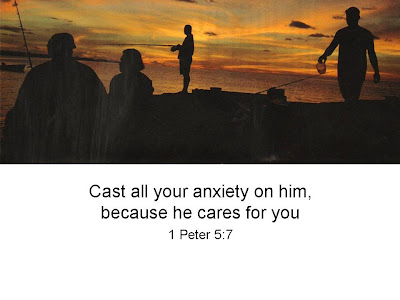
Cast all your anxiety on him because he cares for you

This Sunday we shared in the sacrament of baptism with Tabi. It was a wonderful celebration of the free gift of God's love given by grace to each and everyone of us. It was at the same time a challenge to us all to ask ourselves whether we have made that grace our own by responding to it in faith. What difference does this Christian faith make to us? was the kind of question at the back of our minds as we reflected on 1 Peter 5:7, a verse that one of the senior members of the church shared with 6 year old Tabi.


It’s a bit ironic.

It’s Tabi’s baptism service … but now she’s not with us any more.

That’s actually to miss the point! Tabi and all the children are doing exactly what we are doing – exploring what it means to be followers of Jesus. They are doing it at their level as the Bubbles and Splash groups meet in the second part of our service.

And this baptism service is actually for all of us … it’s not about Tabi. It’s about the difference Jesus can make as he comes into our lives and as we belong to him and we belong to each other.

What difference does our Christian faith make?

First of all, our Christian faith breaks barriers down. We meet together across the age divide and in our church family there are all sorts of different people. It matters to me that the generations mix together – and here at church they do that in quite a unique way. After our Remembrance Sunday service our 102 year old Margaret was at the door with another of our six year olds, Megan. I got them talking to each other. What a remarkable moment. And today, a greeting from Ivy, someone Tabi hasn’t actually met … but who is as much part of our church family as anyone else.

To belong to a church family is to belong to an extended family that breaks down all sorts of barriers. Next week we won’t be here. At 10-00 (note the earlier time!) we shall join with friends from St Luke’s over at St Luke’s. Mixing with another family. That extended family reaches right round the world and brings together people of all races and of all nationalities.

It took time to sink in for Peter. He was steeped in a way of looking at the world that saw it in terms of us and them. His was a world of stark divisions. He didn’t really want to have much to do with the occupying Romans. And then he had a vision. And when the very next day he was invited to the home of Cornelius, a Roman commander, he saw the light.


I could now realise that God treats everyone on the same basis. That’s the remarkable thing about belonging to Jesus and belonging to each other. We are called to be a worshipping people who seek to do what is right and good and make a difference in the world. As we worship and do what is right we are acceptable to him no matter what race we belong to, what background we come from, who we are.

All of this is possible because belonging to Church is all about belonging to Jesus Christ, the Jesus Christ who went everywhere doing good and healing people. God was with Jesus Christ … and our task is to witnesses for him … to share the wonderful good news that through this Jesus we have access to a power beyond ourselves to help us live our lives, and in this Jesus we have a wonderful forgiving love that has the power to renew and strengthen us.

Acts 10:34-43

34 Peter began to speak: “I now realize that it is true that God treats everyone on the same basis.
35 Those who worship him and do what is right are acceptable to him, no matter what race they belong to. 36 You know the message he sent to the people of Israel, proclaiming the Good News of peace through Jesus Christ, who is Lord of all. 37 You know of the great event that took place throughout the land of Israel, beginning in Galilee after John preached his message of baptism. 38 You know about Jesus of Nazareth and how God poured out on him the Holy Spirit and power. He went everywhere, doing good and healing all who were under the power of the Devil, for God was with him. 39 We are witnesses of everything that he did in the land of Israel and in Jerusalem. Then they put him to death by nailing him to a cross. 40 But God raised him from death three days later and caused him to appear, 41 not to everyone, but only to the witnesses that God had already chosen, that is, to us who ate and drank with him after he rose from death. 42 And he commanded us to preach the gospel to the people and to testify that he is the one whom God has appointed judge of the living and the dead. 43 All the prophets spoke about him, saying that all who believe in him will have their sins forgiven through the power of his name.”


I don’t know how you feel. I sometimes feel that the youngsters out there are growing up into a scary world. It’s more than a little un-nerving being a parent today.

I have a sneeking suspicion it has always been the case. When that 102 year old was six the storm clouds were gathering over Europe and the First World War was beginning to loom over the horizon. That was a scary world.

In church we hear each other’s stories. When you listen to all that generation has been through … it’s a scary place, this world of ours. And it always has been so.


It’s special to have that greeting from Ivy today. She’s one of those special people, and there are many of them in our church family and in every church family to go to visit. You might think you do pastoral visiting in order to make other people feel better. The funny thing is that often the opposite happens – you feel all the better yourself!

Ivy is one of those who has drawn on a remarkable strength from her faith in the face of what has been and is a scary world. She has verses she draws on.

One of those verses is in a letter written by Peter when he was a great deal older and in many ways, perhaps wiser. He wrote to Christians everywhere … and his letter very much speaks down through the ages to us in church today.


Make no mistake about it his was a scary world. By the time he wrote this letter a good number of his close friends had been executed in the cruellest of ways simply for following Jesus Christ. He himself, so tradition has it, was to die at the hands of the Romans not long after writing this letter.

And yet, in his older years. He had a very deep and very strong hope. It was a hope that was rooted in Jesus Christ. Peter knew that Jesus had come alongside him in all his suffering and had suffered himself even to the extent on the cross of feeling abandoned by God. That’s pretty severe!

But Peter also knew that Jesus rose again from the dead … and that resurrection released for Peter a very real and very powerful sense of hope. His letter touches on moments of deep suffering. But it is shot through with an indefatigable hope

1 Peter 1:1-5

To God's chosen people who live as refugees scattered throughout the provinces of Pontus, Galatia, Cappadocia, Asia, and Bithynia. 2 You were chosen according to the purpose of God the Father and were made a holy people by his Spirit, to obey Jesus Christ and be purified by his blood.
May grace and peace be yours in full measure.
A Living Hope
3 Let us give thanks to the God and Father of our Lord Jesus Christ! Because of his great mercy he gave us new life by raising Jesus Christ from death. This fills us with a living hope, 4 and so we look forward to possessing the rich blessings that God keeps for his people. He keeps them for you in heaven, where they cannot decay or spoil or fade away. 5 They are for you, who through faith are kept safe by God's power for the salvation which is ready to be revealed at the end of time.


It’s towards the end of that letter that we arrive at the verse that’s so special to Ivy. On Wednesday, as I was preparing for this service, it was the single verse we were invited to read by Josephine Muchelemba who belongs to the church we are partnered with through the Council for World Mission in Zambia.

She was writing in our new CWM book of daily devotion.

I came back to it repeatedly through the day … at our Hy-Way meeting in my visits, not least to Ivy herself in hospital, and as we met together to sift the applications.

It’s a verse that I’ve linked with the greeting from Ivy for Tabi.

It may not be of such importance to her at the moment … but maybe in years to come.

It’s certainly a verse for all of us as parents.

It’s a verse for all of us too.


1 Peter 5:7

Cast all your anxiety on him, because he cares for you.

What a wonderful thought! Anxiety – a state of mind that at times I guess gets the better of most of us.

Cast all your anxiety on him, because he cares for you.

Josephine Muchelemba quotes the verse slightly differently. The difference is not insignificant.

“Cast all your anxieties on him, because he cares for you.”

I guess we each have specific anxieties. As they begin to pile up so that’s what leads to anxiety as a state of mind.

Maybe the way to cast all your anxiety on him, because he cares for you, is to take each of the anxieties that trouble you, in your minds eye one at a time and cast them on him, because he cares for you.

What a wonderful thought.

The prayer Josephine Muchelemba finished her reflection with is not a bad one for us to share as well …

Dear God, help us to put you in control of our lives. Amen.

Tuesday, December 25, 2007

A Problem With Christmas - A Christmas Day Sermon

I have a problem with Christmas.

My problem has to do with religion.

More precisely, it has to do with what religion has become in the last half dozen years or so.

More precisely still it has to do with the rise of fundamentalism in all religions but particularly in Islam and in Christianinty.

Something disturbs me about fundamentalism. Maybe its the rigidity of it, the narrow-mindedness of it, the uneasy feeling there’s too much hate and not enough love. Something about Fundamentalism disturbs me … frightens me. Maybe that’s the thing that’s where the problem lies.

‘One has to understand fundamentalism as a kind of fear,' Terry Eagleton was quoted as saying in an interview in the Observer. 'A theologian friend of mine maintains that the opposite of love is not hate, it is fear. The image of Jesus in the Gospels is of someone who is fearless. People clutching on to their religion or sect are very fearful of what lies beyond, and therefore very dangerous.'

Fundamentalism is driven by fear, it thrives on fear, it breeds fear. It’s not for nothing that it is linked with terrorism. Terror. Fear. That’s the atmosphere of the day.

Maybe the problem I have this Christmas is not so much with religion as with fear.


Fear - the Problem

It’s been a funny old year.

Things have happened that have raised my own ‘fear’ levels.

Whatever the rights and wrongs of the use of the phrase talk of the war on terror leaves its toll – it raises those fear levels in me of ‘the other’. People I don’t know. The press vamps up crime stories and generates a fear as often as not a fear that is unfounded, and yet is still there. We have seen first hand in Gloucestershire the change in weather that’s linked to global warming … and there can be a real fear as the rains get heavier and we wonder … is it going to happen again? Northern Rock is in Newcastle but the holiday company that’s gone bust is based in Gloucestershire – financial fears on our own doorstep. What does the future hold. Bereavements, serious illnesses … have lurking somewhere beneath the surface vestiges of fear, intimations of mortality.


Heed the Christmas Story

Maybe I need to heed the Christmas story this year as much as ever.

After all, fear figures large in the Christmas story.

At the news of the coming of the Christ child Luke tells us that Mary was much perplexed by his words’ The angel said to her, Do not be afraid, Mary.

As the shepherds kept watch over their flock by night an angel of the Lord stood before them, and the glory of the Lord shone around them and they were terrified! But the angel said to them, Do not be afraid.

This is what we need to hear at Christmas.

I want to suggest a double antidote to fear this Christmas.


The First Antidote to Fear

There is a wonderful text in 1 John 4:18.

“There is no fear in love; but perfect love casts out fear.”

Perfect love. That’s what Christmas is all about. The perfect love of God who sent his Son to live alongside us, die for us and rise again to give us life in all its glory. This is the love to set over against those fears.

Fear for myself, fear for someone else, fear of the economic situation, fear of global warming, fear of the rise of fundamentalism.

Whatever the fear that you are aware of … sense anew this Christmas Day the perfect love of Christ taking each of your fears and casting them out one by one.

That’s the first antidote to fear.


The Second Antidote to Fear

The second involves putting something in the place of fear. I want to go back to 1 John 4 verse 7 this time where it says, ‘Beloved, let us love one another, because love is from God; everyone who loves is born of God and knows God. God is love, and those who abide in love abide in God and God abides in them.

The second antidote to fear is to put love into action … at a personal level in our concern for one another. Hope in our villages, towns and cities is something we are going to be hearing more of in 2008 as we seek to build up active love in our own community in our partnership with St Luke’s and St Michael’s … and in our own lives too.

In the face of the rise of fundamentalism I am resolved not to abandon religion but to make the Christianity I believe in work, by putting love into action.

I believe that involves extending the hand of friendship across the religious divide as an alternative to the confrontation of fundamentalisms. It was great to be invited as guests of Imran and his family at the Eurasia and for twenty five of us to enjoy a Christmas lunch. A small gesture … but a very real gesture of friendship.

Our Christmas Day collection is an expression of our love in action as we contribute to the Lilian Elizabeth Fund bringing better health care to the village of Sika in the Gambia.

Our Gift Sunday not only provided a lovely Christmas meal and Christmas presents for everyone at the Day Centre, staff and clients alike, but also raised enough to purchase solar heating panels for a clinic in Malawi.

And Christmas began early as we wrapped parcels for Operation Christmas Child.

So when fears are in danger of taking a hold and making Christmas problematic there are two things to do …


Perfect Love Casts Out Each Fear ... and leads to Love in Action

Heed the Christmas story and let the perfect love of Christ cast out each one of those fears.

And then put something in the place of future, not just anything, but the love that is at the heart of the Christian faith live a life of love in action -– love one another for love is of God and God is love.

Sunday, December 23, 2007

An Offer and a Task for Christmas

I still have problems with Christmas.

It seems so triumphant.

Words from 2 Corinthians 4 speak of the wonder of Christ's light shining in a world of darkness.

For we do not proclaim ourselves;
we proclaim Jesus Christ as Lord
and ourselves as your slaves
for Jesus’ sake.

For it is the God who said,
‘Let light shine out of darkness’,
who has shone in our hearts
to give the light
of the knowledge
of the glory
of God
in the face of Jesus Christ.

This is a wonderful echo of one of the great Christmas prophecies.

The people who walked in darkness have seen a great light.

When I look around, however, it’s not quite like that. There’s a lot of darkness in this world of ours. The darkness of loneliness, the darkness of sorrow, the darkness of deprivation, the darkness of war.

The irony of Christmas is that the darkness is too often accentuated.

The genius of Christmas is that it addresses precisely that issue.


A Vulnerable, Flickering Light

Read on in Paul’s letter to the Corinthians and you find that this light that we treasure not least at Christmas, is a light that is contained in the most fragile of vessels. We have this treasure in clay jars.

It is not an all-triumphant light that shines into every nook and cranny and takes away the darkness for all time. It is a vulnerable, flickering light, that makes its presence felt in weakness, in frailty, in times of immense difficulty.

We have this treasure in clay jars, so that it may be made clear that this extraordinary power belongs to God and does not come from us.

It is an extraordinary power … but this extraordinary power belongs to God and is not dependent on everything going right for us. It is a power that is with us when things go wrong, when things are out of sorts, when we are all too conscious of the darkness.


We are afflicted in every way. That’s something that’s a given. That’s not going to go away, suggests Paul. But we are not crushed.

We are perplexed. Given the nature of the world we live in and the lives we lead that’s not going to go away … but, says Paul, we are not driven to despair.

Christmas does not give us the false reassurance that now the light has come there will no longer be darkness.

While we live, says Paul, we are always being given up to death for Jesus’ sake.


Christmas Offers us an Assurance

It offers us the assurance that no matter how dark the darkness may be the light of God’s presence will still be there … it may at times be no more than a flicker, it may be in a very clay-y jar, but it will continue to glow. continue to shine, nothing will put it out.

Something wonderful comes with that commitment we make to believe.

We believe and so we speak … we know that the one who raised the Lord Jesus will raise us up also with Jesus and will bring us into his presence.

What a wonderful thought.

However dim the light may seem … we do not lose heart. For this slight momentary affliction is preparing for us an eternal weight of glory beyond all measure.

With that sense of blessed assurance, however, goes something more.


Christmas sets us a task to do

We have a task to do. Our task at Christmas and at every other time is to make this light, the light of Christ’s presence, the light that shone in our hearts to give the light of the knowledge of the glory of God in the face of Jesus Christ … to make this light visible.

How can we make this light visible? The clue lies in verse 5 and in verse 11.

We do not proclaim ourselves; we proclaim Jesus Christ as Lord and ourselves as your slaves, your servants for Jesus’ sake.

That’s how we make the life of Jesus visible, that’s how we make the light visible of Christ’s presence visible, that’s how we let the light of Christ shine. While we live we are always being given up to death for Jesus’ sake. That’s not just a statement of the realities of the world. It is also a reminder that Christ calls us to take up our cross daily and be his servants. Our task is to serve Christ by serving one another and serving other people.

That’s the commitment we make through our communion collection for County Community Projects. That’s the commitment we make through our Christmas Day Collection for The Lilian Elizabeth Fund bringing health care to the village of Sika in the Gambia. More importantly that’s the commitment we make through our church’s care in the community and our own daily service of others.

While we live we are always being given up to death for Jesus’ sake. Taking our up our cross daily in a life of selfless service, so that the life of Jesus may be made visible in our mortal flesh, in what we do with our lives.

That’s it. In what we do – in our lives – in our mortal flesh – in our day to day living – this is what will make Jesus visible. This is what will enable the light of Christ’s presence to shine in a world of darkness.

Two things then.


Christmas Offers us Assurance and Sets us a Task

Assurance – no matter how dark the world, the light of Christ’s presence shines on, however vulnerable and weak the flickering flame may seem. Hold on to that … sure of an eternal weight of glory beyond all measure.

Making the life of Jesus visible, the light of Christ’s presence visible, through the service of Christ, and through the life-time service of others in their need – this is the task we are called to at Christmas.

Here are the words that Paul shared with the Christians of Corinth.

2 Corinthians 4:7 - 5:1

But we have this treasure in clay jars,
so that it may be made clear that this extraordinary power belongs to God
and does not come from us.

We are afflicted in every way, but not crushed;
perplexed, but not driven to despair;
persecuted, but not forsaken;
struck down, but not destroyed;
always carrying in the body the death of Jesus,
so that the life of Jesus may also be made visible in our bodies.

For while we live, we are always being given up to death for Jesus’ sake,
so that the life of Jesus may be made visible in our mortal flesh.
So death is at work in us, but life in you.

But just as we have the same spirit of faith that is in accordance with scripture—
‘I believed, and so I spoke’—
we also believe, and so we speak,
because we know that the one who raised the Lord Jesus will raise us also with Jesus,
and will bring us with you into his presence.

Yes, everything is for your sake,
so that grace, as it extends to more and more people,
may increase thanksgiving, to the glory of God.

So we do not lose heart.
Even though our outer nature is wasting away,
our inner nature is being renewed day by day.
For this slight momentary affliction is preparing us
for an eternal weight of glory beyond all measure,
because we look not at what can be seen but at what cannot be seen;
for what can be seen is temporary, but what cannot be seen is eternal.

For we know that if the earthly tent we live in is destroyed,
we have a building from God,
a house not made with hands,
eternal in the heavens.

Saturday, December 22, 2007

Sing to the Lord a New Song - Diana Adams

Diana Adams adapted and read this Reflection by Carole Elphick at our Choir Carol Service. It is taken from A Chair Pulled to the Place of Prayer, the prayer handbook for 2008.

Imagine a conversation between people planning an act of worship such as ours this evening –
(and I did say “imagine” - because this did not actually happen!)

“We must include ‘Hark the herald angels sing’
and ‘Silent night’
and ‘Once in royal David’s City’
O yes - begin with ‘Christians awake’
but if we have ‘O little town of Bethlehem’ – do make sure it’s the right tune!
And, if we must get funky, we could include ‘Come and join the celebration’.”

But new songs? At Christmas? Forget it!
People expect to have the old carols.
That’s what they come for.
They want to feel comfortable,
as if we’ve been polishing the cross and baking mince pies since last Christmas,
so they can find everything just as it was before.

But what if, just for once, we had a change, and used some of those carols
about unmarried mothers
overbooked hotel rooms
shepherds so terrified they ran to Bethlehem
wise men so mistaken that babies and toddlers were slaughtered?

What if we even took it further
and sang songs about how God can take our pain and transform it.
How living in the church is hard because we do not agree, and don’t know how to differ.
How everyone’s secret fear of not being good enough,
or of having committed the sin for which there is no forgiveness,
can be taken, soothed, challenged, changed;
and how our lives can be changed –
re-charged, revitalized, re-inspired
simply by knowing that God is with us.

Maybe then we will go on to write the song of our lives
with re-newed hope in our hearts - so that others may sing in their turn.

Richard challenged the evening congregation here last Sunday “to be open to change” –
two thousand years ago John called on the people “to repent and change their ways.”

So, instead of finding everything as it was last year,
what if God’s Christmas guests found a renewed, open, accepting people
ready to change
ready to look within themselves and spot the areas that need to change
people ready to listen
ready to sing the terrifying song of the angels in a new chromatic key
instead of monochrome uniformity.

Change isn’t a bad thing – it’s a way of moving on, on our Christian journey -
so, may the light dawn for each of us,
may we accept the babe of Bethlehem into our lives –
may we move forward on our journey, through Christmas and into the New Year, with re-newed hope in our hearts - Emmanuel – God is with us.

After all, even ‘Silent night’ was a new song once.


Choir: “Change your ways, change your ways, cried the prophet John.
God’s own king is coming soon, so who’s side are you on?
Change your ways, change your ways, cried the prophet John.
God’s own king is coming soon, so who’s side are you on?”

"Sing to the Lord a New Song"
by Carole Elphick
from A Chair Pulled To The Place of Prayer,
the Prayer Handbook for 2008
© The United Reformed Church 2007

Saturday, December 8, 2007

Christmas Hopes - Fantasy or Reality?

I have a problem with Christmas.

We are invited to dream dreams that can never be achieved. We are tempted to live out fantasies that are not attainable. Whether that dream of a white Christmas is realised or not remains to be seen. One suspects that in all too many households the fantasy of the ideal family celebration will not be realised.

It is all too easy to put many of the favourite readings for Christmas that we shall share over the next couple of weeks into the category of dreams that can never be achieved, fantasies that are not attainable.

Will the people who walked in darkness really see a great light? Will there be endless peace? Will there be justice and righteousness from this time onward and forevermore? Will the wolf live with the lamb, the leopard lie down with the kid? Will a little child really lead them? Will they cease to hurt and destroy on my holy mountain? Will the earth really be filled with the knowledge of the Lord as the waters cover the sea?

Is all of this no more than a dream … an idle fantasy, lumped in with all the other trappings of Christmas and then to be quickly forgotten?

I believe that what’s going on inside these readings is something very different.

Individually and collectively these readings give us a glimpse of what it is like when God’s rule takes a hold in our hearts, in our homes, in our communities and in our world.

When God’s rule takes a hold then light does come into people’s darkness, there is peace, justice and righteousness do prevail.

Our conviction is that ultimately God’s rule will take a hold and the new heaven and the new earth will come to be.

But our Christian conviction is more than that. It is that in Jesus Christ God’s rule has broken into our world. He calls us to make these things real here and now.

Take today's reading from Isaiah 65:17-25

For I am about to create new heavens and a new earth;
the former things shall not be remembered or come to mind.
But be glad and rejoice for ever in what I am creating;
for I am about to create Jerusalem as a joy, and its people as a delight.
I will rejoice in Jerusalem, and delight in my people;

no more shall the sound of weeping be heard in it, or the cry of distress.
No more shall there be in it an infant that lives but a few days,
or an old person who does not live out a lifetime;
for one who dies at a hundred years will be considered a youth,
and one who falls short of a hundred will be considered accursed.

They shall build houses and inhabit them;
they shall plant vineyards and eat their fruit.
They shall not build and another inhabit;
they shall not plant and another eat;
for like the days of a tree shall the days of my people be,
and my chosen shall long enjoy the work of their hands.
They shall not labour in vain, or bear children for calamity;
for they shall be offspring blessed by the Lord— and their descendants as well.
Before they call I will answer, while they are yet speaking I will hear.

The wolf and the lamb shall feed together,
the lion shall eat straw like the ox;
but the serpent—its food shall be dust!
They shall not hurt or destroy on all my holy mountain,
says the Lord.

It is not just a dream, far less a fantasy.

It gives us a glimpse of what it is like when God’s rule takes a hold … and it maps out for us what we must do as we seek to make these things real here and now.

If the sound of weeping or the cry of distress should no longer be heard then our task is to give comfort to those who weep and to alleviate distress.

If an infant should live more than but a few days and an old person live out a lifetime, our task is to care for children and to care for older people with equal commitment.

If people are to dwell in houses they call their home, we cannot turn a blind eye to homelessness.

If people are to eat the fruits of the earth, we cannot turn a blind eye to those who are hungry … neither can we turn a blind eye to issues of unemployment if people are to enjoy the work of their hands.

We are called to be peacemakers and given a ministry of reconciliation because this is what it’s like when God’s rule takes a hold: the wolf and the lamb shall feed together, they shall not hurt or destroy.

The great Christmas readings are not the stuff of dreams or fantasy, they shape what we are to do here and now.

That is why this Christmas we have identified four things that we are supporting:

1. last week’s Gift Sunday focused on the people who come to our Day Centre,
2. and the Present Aid catalogue of Christian Aid.
3. Our Communion Collection is for the work of Cheltenham Community Projects – who incidentally are crying out for food parcels here in Cheltenham at the moment.

4. And our Christmas Day Collection will be for a remarkable project that has been initiated locally and seeks to bring better health care to the villagers of Sika in the Gambia. Jennifer Taylor and Lyn O’Farrell have both been very involved in that project and they are going to tell us something about it now.


It was after visiting the deprived village of Sika in The Gambia, that Jennifer Taylor (founder member of the charity) was inspired to build a medical centre in memory of her late sister Lilian Elizabeth.

Lilian had spent time in the Gambia before her unfortunate premature death and had always enthused about how friendly and warm the people were, despite their hardships.

Jennifer's inspiration came from experiencing this warmth & friendliness first hand and after witnessing the devastating effect that both malaria and the lack of medical treatment is having on the villagers.

Malaria is the biggest cause of death in the Gambia.

The village has no electricity and the living conditions are very basic. To date Jennifer has already improved their standard of living by funding the building of a well. In an attempt to reduce the incidents of malaria and with the aid of generous donations, she has also been able to supply 500 mosquito nets to the families in the village.

The cost of building the medical centre will be around £50k but to maintain it, we will need £5k per annum by way of donations and subscriptions.

The centre itself will be staffed predominantly by locals, as it is important to retain their cultures and beliefs. Occasionally volunteers from the UK will visit and help out in any way they can.

Jennifer also wishes to introduce a feeding programme, as during several months of the year they have little or no food.

Please note. All monies donated go straight to the charity as there are no overheads or wages taken by the volunteers.

For further details on how you can help, for updates on how the medical
centre is progressing and photographs of recent visits please visit the Lilian Elizbeth Fund website


So much to pass on at Highbury

If you give a little love you can get a little love of your own

A blessing shared at Highbury

Now and the Future at Highbury

Dreaming Dreams Sharing Visions at Highbury

Dreaming Dreams Sharing Visions

Darkness into Light