Sunday, March 8, 2009

In the beginning ... God

It’s been great talking to 5 year old Murray about today’s baptism – the questioning and the comment keep you on your toes – the theology is quite profound as much in the questioning as in the answering.


A couple of weeks ago I found myself eavesdropping on a wonderful conversation between four 5 or 6 year olds on a school trip to the wonderful Nature in Art gallery at Twigworth.  Adrian Stanley had always wanted me to visit and I got round to going a couple of weeks ago.  He had always waxed eloquent about the opportunity you had to see an Artist in Residence at work in their studio.  I made a bee line for the Artist in Residence’s studio.  As it happened there  were two Bennet’s buses in the car park and a Gloucester Infants school going around the Art Gallery in small groups of four.  One such group were deep in conversation with David Miller about his wonderful paintings of fish.


Their questions were wonderful.  They ranged over the whole process of painting the artist engaged in.  From the underwater photography he did as a diver while wearing a decoy bird on top of his head (is that to trick other people?  they asked.  No, to trick the fish he said in reply)  through the first pencil sketches (is that the same pencils as we use?  Yes, he said.  Ours are shorter, they replied a little indignantly), to the studies that he was in the process of painting in the studio (But there isn’t a pier in the photo!  No, that’s the beauty of being a painter I can put the fish under the pier!  So, you’re tricking people.  No, I’m not tricking people, the artist insisted, there’s one I finished yesterday.  You couldn’t have finished it yesterday, you’re tricking us.  No, I’m not tricking you!  That’s really good.  Do you have to wait until it’s dry before you paint the fish on to the water.  No, it’s called wet on wet painting with oils.  I would wait until it’s dry to do the real detail in a painting) right through to the wonderfully, detailed finished painting of beautiful fish.


Then the final set of questions that caught my attention.  How do you paint the scales?  It has to be said the fish shone and the scales were beautiful in the finished painting. 


“I count them,” David Miller replied.  And then he went on to explain that each fish of the same species has the same number of scales.  “If you are going to paint them, you need to count the scales.  Some artists try to paint a fish without painting the scales and the fish never looks quite right.  You need to count the scales.”


So there you have it.  The secret was out.  Whether any of that group of youngsters, their teacher or I will ever aspire to the heights or is it the depths of painting fish I somehow doubt.  But the six of us have now been let into the secret.  And we know if we are going to have a go we’ll have to count the scales.


It was a wonderful way to spend a very special day.  I was in a mood to celebrate.  It was Darwin’s birthday.


I wanted to turn the conversation to Darwin and the Origin of Species and ask why each species of fish has a particular number of scales.  But it was not for me to join in the conversation – there was already another group of four little ones raring to have a go … and an immensely patient painter all set to answer another set of questions.


The questioning of those four five year olds set me thinking.


He was a painter.  He used photographs but then he went on to paint the fish and the birds he so carefully observed.  It was as if painting gave him a greater freedom.  He could put the fish under the pier.  His painting of the pier was wonderfully accurate.  His painting of the fish was equally so.  But the fish weren’t under the pier in his photo.  They might well have been at some point.  He was able to paint the fish.


Was he ‘tricking’ us?  Or was he presenting the reality of that underwater world with not so much poetic license as artistic license?


What came home to me was the way in which reality can be portrayed not simply by the accuracy of a photographic record, but by the artistry of a painter.


We do the Bible a grave injustice when we read it as if it was written as a 21st century scientific treatise.  The Bible tells me the truth that the world we live in is the world of God’s creation.  It tells me that timeless truth through wonderfully rich poetry and story.


To me that leaps off the page as you read about creation.  There are wonderful rhythms and a beauty of language in Genesis 1 with those sonorous words, In the beginning … the repeated refrain, and God saw that it was good, the rhythm of ‘And there was evening and there was morning, the first day, And there was evening and there was morning the second day.”


This is the stuff of poetry.  And it is not tricking us!  The poetry of Genesis 1 confronts us with the truth that the world we live in is the world of God’s creation.  As it builds to its climax it challenges us to realise that we must look after God’s world.


It is in poetry that the Bible has most to say about creation – Genesis 1 is not the only place that tells us about the creation of the world.  There are great passages in the Psalms and most powerfully of all in the Book of Job that tell of creation.


Take Job 38.  It speaks of God ‘laying foundations’ for the earth, measuring the earth by ‘stretching a line’ upon it.  It speaks of the bases the earth is built on, it speaks of God laying a cornerstone for the earth.  It speaks of the morning stars singing together.  It speaks of the sea being shut in with doors, and then bursting from the womb.  It speaks of clouds as a garment and thick darkness as a swaddling band.


This is not a scientific description of the world, it is powerful poetry at its best.  And it is not tricking us!  The poetry of Job 38 confronts us with the truth that the world we live in is the world of God’s creation and it is awesome and fills us with wonder and awe.


It confronts us with that truth for a particular purpose.


The book of Job is a book that grapples with one of the greatest problems we all face.  It is the problem of undeserved suffering.  Job is perfect and upright – he has done nothing wrong.  And yet everything goes wrong in his life.  He loses his possessions, he loses his family, he loses his health … and he is brought to the pits of despair.


Three friends in turn, and then a fourth try to console him with reasoning and a lot of theology.


But none of their arguments is persuasive at all.


The problem remains.


It seems as if it cannot be resolved.


Job is left desolate and alone.


And in his solitude in the midst of the storm – it is then that he is brought face to face with a power that is greater than anything he can conceive.


Then the Lord answered him out of the whirlwind …


But the voice of God gives Job no answer to his problem.


In a prolonged series of questions that begins at chapter 38 and goes on for four whole chapters Job is confronted with the immensity of God in the wonder of his creation.


Where were you when I laid the foundations of the earth?

Who determined its measurements?

On what were its bases sunk or who laid its cornerstone

When the morning stars sang together and all the heavenly beings shouted for joy?

Who shut in the sea with doors when it burst forth from the womb, when I made the clouds its garment and thick darkness its swaddling band?


Job has no answer to the tragedy of his suffering.


Job senses the reality of a God who is greater than anything he can begin to conceive.


And he is filled with awe and wonder … he has moved from philosophising and theologising about God to sense the reality of God.


The book of Job does not come up with answers.   What it does is to show that in the presence of an awesome God it is possible to live with unanswered questions as we sense the immensity of the God who is greater than anything we can begin to imagine.


You could say David Miller had the patience of Job in answering the questions of those five year olds.


Faced with life’s unanswered questions we need not only the patience of Job but his sense of the reality of God.


How can we sense that reality?


Look at the fish and try counting those scales.  Look at the birds of the air.  Go up on the hills.  Go out into the night sky and listen out for the singing of the starts in all their mysterious silence!


But there is one thing more we can do.


We can look to the God who in the beginning created the heavens and the earth and see that this God has become one of us … in Jesus Christ we can see his grace and his glory.  Look not only to the beauty of God’s creation … but look to Jesus.  And what do you see, someone who comes into a hurting world to bring healing.  Who comes into our hearts to bring love.


We are going to take a look at the last week of Jesus’ life in particular as Holy Week unfolds and Easter approaches and each day of Holy Week have the church open in the morning and again in the evening – for quiet reflection.  You can follow that week on our web site as well.  Look at the way God was in Christ as he experienced the suffering of that week, the agony of the cross.  God was in Christ through all that suffering and pain.


In a world that confronts us with so many unanswerable questions sense that Christ is with us in the depths as much as in the heights and find strength in his presence.


Of the little ones parents brought to Jesus, Jesus said, let them come to me.


To each of us weighed down by unanswerable questions this same Jesus says, Come to me all you that labour and are heavy laden and I will give you rest.

Sunday, March 1, 2009

In all things ... God

I like having company when I do the washing up after Sunday lunch.  And Geoffrey Smith has been good company.  A stalwart on that favourite after-Sunday-lunch programme on Radio 4, Gardeners’ Question Time and many a TV gardenin
g show – I have enjoyed his gentle sense of humour.   As tributes were paid to him over the weekend following his death at the end of this week, one comment caught my attention.  He had a love of the garden and of things that grow – so much so that he would talk to them and lovingly nurture them.  He had a recipe for those times when things get on top of you.  When things were weighing him down he would simply look at a flower.


Geoffrey Smith is in good company.  The book of Job tells the story of someone weighed down by the ills of the world.  It is the book in the Bible that grapples with unwarranted suffering and poses the question how can you cope when everything goes wrong.


The Book of Job recognises the truth Geoffrey Smith held so dear.  It is in the book of Job that some of the finest passages celebrating the wonder of God’s creation appear.


Time and again Job senses the awesome nature of God and as he looks at the beauty of God’s creation he holds it in wonder and in awe.  As the book unfolds it is that sense of wonder and awe he has with the God who is beyond all his understanding that he is able to look at his own situation and get it somehow into perspective.


Here in Job 9 he has a sense of the awesome power of the God of creation as he looks at the mountains and their grandeur, at the beauty of God’s world, and as night falls he looks up into the night sky and senses the wonder of God.


It was from Job 9 that our Call to Worship came.

God is so wise and powerful

No one can stand up against him.


We cannot understand the great things he does

And to  his miracles there is no end.

As we gather together in our worship, how good it is simply to wonder at the greatness of God.  Let’s do that as we read one of those passages, let’s couple with it one of the wonders of God’s world here on our doorstep – the River Severn with the second highest tides in the world, as Jenny and Ted saw it the other week, the snowdrops at Colesbourne and the night sky in all its splendour!  After our reading we will sing our praises to God.


Job 9:1-10


A time of praise and worship with Hy-Spirit


I am so frustrated when science and religion are seen only to clash with each other.  The more I learn about science the more in awe I am at the wonder of the world of God’s creation.


Some people, not least those scientists who reject any belief in God, with an eighteenth century, philosophical idea of God that is not a very helpful way of understanding the nature of God.


It received its classic formulation by someone called William Paley.  He suggested that if you discovered a watch with all its intricate mechanism lying abandoned in a field you would be quite right to deduce from a study of the watch that it had been made by a skilful watchmaker.


Look at anything in the garden, not least one of those wonderful flowers that meant the world to Geoffery Smith and you can conclude they must have been made by a skilled flower-maker – and that’s God.


It’s all right as far as it goes.  But it’s not the only way of seeing God.


I think it’s helpful to go back beyond William Paley to earlier ways of seeing God.


It was not so much that God is like a watchmaker who has made his watch and there it is.  Rather God is in all things.


Take the 17th century poet, George Herbert and one of the hymns that I have chosen for a marathon hymn sing in aid of the Anthony Nolan Trust: its opening words catch something for more helpful for me …


Teach me, my God and King,

In all things thee to see.


Now that opens up a different set of possibilities.  Look at the wonder of anything in the natural world and in the universe and beyond … don’t look for a mechanistic deity like the watchmaker.  Instead, learn to see God in all things.


He is there at the beginning, he is there in creation, he is in that life force that energy that brings things into being.  He is there at each stage of evolution.  Whichever way evolution goes, whichever branch of the tree survives – God is there.


Teach me, my God and King

In all things thee to see.


For there is nothing in the present or the future, in height or in depths, nothing in the all of creation that can separate us from the love of God in Christ Jesus.


George Herbert was living at a time of great scientific advance.  Having been born in Montgomery, he had spent a short while in Oxford University, before becoming Public Orator of the University of Cambridge.  Thomas Harriott, the Professor of Mathematics at Oxford University was one of those on the cutting edge of scientific discovery.  An astronomer he had accompanied Walter Raleigh as navigator on his voyages of discovery.  He had been implicated in the Gunpowder plot, and he ended up teaching mathematics and astronomy in the University of Oxford.


It was 400 years ago this year that Thomas Harriot made a remarkable instrument using lenses and tubes.  He was one of many all over Europe racing to develop a way of looking at the stars and at the moon that would take the world by storm.  It was not Thomas Harriot who got the accolade for being the first to use this new scientific device.  It was Galileo Galilei.


As Galileo’s story is told at his 400th Anniversary in this International Year of Astronomy it is sad that people will dwell on the clash between church and science once again.


The reaction of those in the church who rejected Galileo and hounded him out, was not typical of everyone.


George Herbert was one of those not troubled by the advances of science.  He simply found it even more awesome as those advances opened up for him the wonder of God’s world.


It was between 1613 and 1615 that the word ‘glass’ was first used of a telescope.  It wasn’t long after that that the deeply devout George Herbert wrote this poem as part of a collection only published after his death that explored the depths of the Christian faith in the most wonderful of ways.


You can just imagine the scene – he has seen his first telescope.  His first glass.  It is beautifully crafted from brass – a precision made instrument.  It’s enough just to look at it in wonder at its beauty.  Indeed you can picture George Herbert walking around it and letting his eye rest on it.


A man that looks on glass

On it may stay his eye.


How true.  Simply look at this remarkable piece of engineering and marvel.  But wait a moment there’s more that you can do.


Take it out into the dark of a clear night sky.  And then don’t simply allow your eye to rest on it, but put your eye to the eye piece and look through it.


Imagine, you have never seen a telescope before. You have never looked through a telescope at the moon, at Jupiter, at Venus or at the stars!


It’s wonderful.


A man that looks on glass,

On it may stay his eye;

Or if hepleaseth, through it pass,

And then the heaven espy.


Wonderful.  Here in this poem, we encounter the awe and wonder that science evokes in the  heart of a deeply devout believer in God.


That’s the awe and the wonder I shared with the  Brownies at their sleepover last weekend as we went into the garden and spotted the very things Job had seen – the bear, the hunter, the Pleiades.  There they were.  And we could all see them.


Teach me, my God and King

In all things thee to see.


But this awe and wonder in George Herbert’s heart did not only make him see things differently, it made him do things differently too.


See God in all things, and all things become important in the eyes of God and in the presence of God.  Even the littlest of things in what we do in our lives  become all important.  On this St David’s Day it is not only St David who celebrated the little things, it is the little things that George Herbert of Montgomery wants us to see to be all important.


Teach me my God and King

In all things thee to see

And what I do in anything

To do it as for thee.


This is exactly what Paul is getting at.  As we come to the realisation that there is nothing in all of creation that can separate us from the love of God in Christ Jesus, so we need to realise that in living our Christian lives we must heed his words in Colossians 3:17.  Whatever you do, in word or deed, do everything in the name of the Lord Jesus, giving thanks to God the Father through him.


Do everything in the name of the Lord Jesus.


That if you like is the measure of everything we do.  Is this something I can do in the name of the Lord Jesus?  It is also the spur to all we do.  Do everything in the name of the Lord Jesus.


If mathematicians and astronomers were making discoveries about the universe, chemistry was still in its infancy.  Alchemy was the quest to find a substance that would turn base metal to gold, the dullest to the shiniest and most splendid of metals.  Such a substance had a technical name:  tincture.  Others were looking for an elusive stone that would turn all tings to gold.  To find that most famous stone that turns all things to gold was the quest many set out on.


George Herbert was sceptical of such a quest: in due course alchemy proved very much a dead end.


But do everything in the name of the Lord Jesus and the dullest things can be transformed.  Maybe this is the tincture that can turn the dross of our daily humdrum living to the gold of God’s presence.


The thing is that this is open to everyone.


All may of thee partake:

Nothing can be so mean,

Which, with this tincture, “For thy sake”

Will not grow bright and clean.


Do things for Christ’s sake.  Whatever you do, do it “for thy sake’ and see the difference it makes.  All things grow bright and clean.


The tincture is this ‘clause’  “For thy sake”


This applies across the board to the very meanest of tasks.  Maybe even washing up after Sunday lunch!


A servant with this clause

Makes drudgery divine;

Who sweeps a room, as for Thy laws,

Makes that and the action fine.


This is the famous stone

That turneth all to gold:

For that which God doth touch and own

Cannot for less be told.


That’s the whole point.  God’s touch is on everything.  Everything is God’s.


Teach me, my God and King,

In all things thee to see

And what I do in anything

To do it as for Thee.


Friday, February 20, 2009

Serving God

a sermon preached by Becky Hartwell on Sunday, 15th February

 Now last week Richard talked about serving God, it was moving on from the 18+ event that never happened.  In the morning he talked about serving God, by serving others.  Because the fruit of the love of God is at work within us and through this it becomes a joy.


And this evening while talking about serving God I want to focus on the idea that serving God doesn’t always have to be something we work up to, something we plan for years, something that can only be done under certain circumstances.  We don’t have to be missionaries, church ministers, doctors in shanty towns.  Instead, serving God can be the day to day things, bringing up your children, helping out a stranger, taking care of someone who needs it.


Encouraged by Richard’s services I decided to also look at serving God, looking at those who have served God in unusual ways, or in subtle ways.  While trawling through the mass of information on the internet I found something quite interesting, something called “Sunday School Teacher Appreciation Day”.  Now, I myself have never heard of such a thing, as it turns out it is an American thing.  And yet for all of us who went to church as children we understand the affect that a Sunday School teacher or Junior Church leader has.


But I would encourage us all to think of those who have affected our spiritual journey.  It may be that there have been so many people, those we’re not even sure the names of but people who through their words, their actions and their kindness. 


Personally for me, there have been children’s leaders, youth workers from our Federation events, family, friends and some lovely ladies from churches when I was growing up.  But there were those who unknowingly had an affect as well.  My friends from university who weren’t Christians but were aware of my behaviour, they knew I was a Christian and were interested on how that affected my behaviour.  No matter what happens we have an affect on those around us, it just depends what sort of affect it is.


There is a theory called Locard’s exchange process – now I don’t use intelligent theories in talks often so let’s just hope I can explain it.  In television shows like CSI – Crime Scene Investigators, they can pick up dna or clues because when a person has been at the scene something of the location will be left on the person and vice versa.  It is explained as this “with contact between two items, there will be an exchange”.


So what does that mean for us?  Well, it is true for us as well, with contact between two people there will be an exchange. 


We remember, even for a short time a rude shop assistant, a helpful person with directions – when I was travelling I remember the towns that had the polite people and those that didn’t.  We can remember those that have challenged us as Junior Church leaders have, those that have left us happy, sad, angry or confused but we do remember people. 


In that Locard’s exchange process rings true for us as people, and if we remember others do they remember us?


Undoubtedly there are people who have been so grateful for the flowers they have received, an activity that runs well at the end of services but has an affect.  There are those who remember having someone at church chat to them the first time they came, and one of the children even said to me a couple of weeks ago, “Come on Becky, do one of your little prayers” – people remember the contact we have with them.


So with contact with two people there will be an exchange.


If we look to the story of Jesus washing the feet we can see that exchange.


We can see how Jesus affected his disciples, the man they saw as Lord and teacher was kneeling down to wash their feet.  Imagine our teachers doing that for us.  The one we see as the most powerful, important, humbling themselves completely in love and service.  The love that Richard talks about.


Jesus wasn’t doing this act because it was all about a lesson, he could have done the same lesson in a different way, without getting his hands dirty.  He knew he was going to die soon, he was going to suffer, be tortured, be in complete pain and in fact be rejected by the men he was bending down to wash the feet of.


But he chose that moment to bend down and wash their feet.  These weren’t beautifully manicured feet that had been washed that morning and then kept in socks and shoes.  These were sweaty feet, dirty from walking round the streets probably with marks, grazes and other things on them.  He wasn’t humbling himself in a picture perfect postcard way, he was humbling himself in a complete act of service.  In an act of love.


The exchange process was there for the disciples as well.  We can always see the affect Jesus has on others, whether it be aiding them to feel loved, welcoming children to him, confusing and angering the Pharisees.  But the disciples also had an affect on Jesus.


Later on in John we hear of Jesus being troubled in spirit, and we hear of his annoyance that the disciples were sleeping while he was praying in Gethsemene.  Jesus came as a person with emotions and taking on experiences in life, people affected him as well as him affecting them.


When asked questions by the disciples in this passage Jesus answered with honest, real answers.  He didn’t fob his disciples off with things that would just shut them up.  Jesus spent time with them, he spent time as a human on earth.


Jesus is a man who served with his heart, an incredible example and a man who has had the biggest effect on our lives.  Jesus did huge acts of service, things that seem to be watered down by calling them service.  We know he died for all of our sins and yet in comparison the washing of the feet is minuscule.  This small act still stands out though as an important act of service.


But what about other people in the bible who showed acts of service.  There are the stories that involve a lot of action, planning and time, for example Noah and King David.  Then there were the smaller things, where people served God then and there, taking the gifts that God had given them and then giving them back to him in service.  There was Esther, a beautiful lady who became a Queen and with the help of others saved the Jewish people.


Or the story of Paul and Silas, serving God while in jail.  And there was Mary, the mother of Jesus, a lady who when so young gave birth to the Saviour of the world.


Instead we heard the story of the birth of Samuel.  Samuel became a very important man in the story of God’s people, a judge, a prophet and the man who anointed King David.


However, when we meet him here he is just a baby.  A baby that is truly longed for by his mother.


But what makes this a story about someone serving God.


In her prayers to God, Hannah says that she is his servant.  Often we forget how we can be serving God in our daily lives, we may consider it is something we can do in years to come, when we are “better” Christians, when we are praying over thirty minutes a day, when we have not done anything wrong in a twenty-four hour period.  And yet, in this moment Hannah is saying she IS God’s servant, even though she hasn’t had her child. 


Hannah established in her prayer that she was God’s servant.  But that if he gave her what she desperately wanted, she would in fact give it back to him. 


Hannah didn’t pray a selfish prayer, she wanted to serve God even in her pain.  She was willing to be humble and stated she was a servant of God.


In some ways, Hannah’s prayer seems like the type we might say when we are desperate, or the ones we frequently hear on tv “God if you do this for me… I will be a really good person…I won’t ever been mean to someone again…I will go to church every Sunday”.  But Hannah’s prayer was more powerful than that.  She would have known God wouldn’t have ignored words like that, Hannah was praying honestly and humbly.


And so it came that when Samuel was born, Hannah gave him back to God.  She kept her promise and took him to the Tabernacle.  She was giving him to God.


Hannah was a person of the bible, not hugely featured, just in two chapters but in the situation she was in she served God – she wasn’t a judge, she wasn’t a prophet, she wasn’t the wife of a King but she served God through prayer and having a child.


This story of Hannah and Samuel enables us to think about the gifts God has given us.  In the same way when Hannah had a choice to make with Samuel, these are gifts that we can choose to give back to God, given back to him through serving him and his people.


There is a story in a book I have read about a person who is given a special tea set, very posh and beautiful.  But this tea set is kept in the attic, wrapped up in paper for a special occasion.  But an occasion special enough never happens and eventually the tea set just sits, hidden and never used.  Then one day the owner dies, their children find the tea set and use it.


Our gifts from God can end up like this tea set, he gives them to us so we can serve him and his people but if we keep saving them til the right time we might never use them.


So service is something that we have lots of examples in the bible.  But as Richard has talked about it needs to be grounded in God.  The joy comes from loving God. 


When I talked about Locard’s exchange process before I talked of how when we meet someone we make a choice, have a good effect or a bad effect.  But as we have an affect they also have an affect on us.  If we spend all our time serving God but never time with God we will be affected by all the things we see, we receive.  There is a lot of suffering, pain and sadness in the world.  This can and does have an affect on us.  So we need to stay grounded in the love of God, we need to still immerse ourselves in his word and stay in prayer with him.


We can come to Jesus in everything, and ask for him to renew us, we can develop our learning and understanding of him, we can embrace all that he has to offer us.  Serving isn’t a lonely thing, it comes with the love of Jesus.


So we see that small acts can make a large difference, as I said at the beginning serving God isn’t always about the big acts but the small things also have a significance, the prayer and being a parent, the washing of feet and the being a Junior Church leader.


So as Richard said last week, what difference is hearing this going to make? 


  • Maybe we can think what is our tea set?  What are we holding on to for a special occasion?


  • Maybe we need to be remembering those who have served God by being there for us.  Those who have had patience and love for us, even when we weren’t hugely likeable people.  Or maybe those who have served us and gone unnoticed, those who have been involved in the small things that might not transform lives immediately but might have such a gradual effect we didn’t realise it.  And thank God for their service.


  • Or just maybe we can say to God, “use me”.  A scary thing to say to God because he doesn’t ignore those words.  Maybe as we go home from here or get up tomorrow morning we can ask God to use us for that day, for the walk we might be taking or the people we will meet.  We can ask God to help us serve him better.
    • Little random acts of kindness, story of people who pay for toll booths but then get ignored
    • Trying to leave earlier so to be a better driver


Finally I am going to leave you with some words that were made by a man called Robert Fulghum, a man who understood that things can stop us.  A man who also saw that it was possible to do small things in serving God if we are willing to use what we have in the moment.


She strode to the rostrum and changed the agenda of the conference from intellectual inquiry to moral activism. She said, in a firm voice to the awed assembly: "We can do no great things; only small things with great love. "


The contradictions of her life and faith are nothing compared to my own. And while I wrestle with frustration about the impotence of the individual, she goes right on changing the world. While I wish for more power and resources, she uses her power and resources to do what she can do at the moment.


Sunday, February 8, 2009

Sustaining Service of Others and of God

Had it not been for the snow we would have welcomed the CF Youth 18+ event this week. A fun time together they were going to explore the invitation at the heart of the Christian faith to service. They would have been sharing stories together and hearing from people from church as well.

John Lewis is one of those who would have shared his story now. Our honorary deacon, John has shared in a lifetime of service, not least through teaching, Samaritans, work for Dowty House, a residential care home in Cheltenham, and here at Highbury. For him as for all of us, Service is at the heart of what it takes to be a Christian.

But that kind of service can be difficult to sustain.

Is there anything in our Christian faith that can help us to sustain a life-time of service to one another and for that matter for God.

We share with many of other faiths and of no faith a commitment to service. There is nothing distinctive about that. Our call to service comes from the imperative to love that is at the heart of our Christian faith.

“This is my commandment,” says Jesus in those words we read from John 15 earlier, “that you love one another.”

“A new commandment I give to you that you love one another as I have loved you. By this shall everyone know that you are my disciples if you have love one for another.”

At every turn ‘love’ is the order of the day for the Christian.

Couple that with the commitment to the poor, the quest for justice that is implicit within that command to love and the imperative could not be clearer. And anyone who takes it seriously will find it an obligation impossible to fulfil.

We often think of religion as laying demands on us. We should do this. We should do that. We should not do the other. And this is the greatest command of them all – to love.

Some even speak of religion as ‘an obligation’. There are, so they would have us believe, religious obligations that we need to meet.

Ought, ought, ought.

Such demands lead to burnout and have the potential to give rise to depression. You can never do enough.

Something is needed to sustain that kind of service and love.

Those words from John 15 are interesting.

They come not at the beginning but at the end of a famous passage.

Let’s hear the passage in full and notice the sequence of thought.

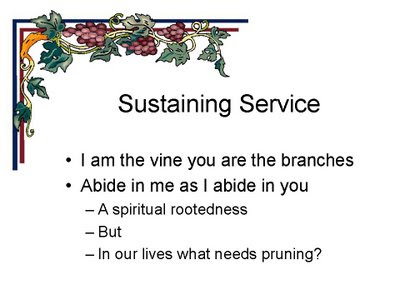
‘I am the true vine, and my Father is the vine-grower. 2He removes every branch in me that bears no fruit. Every branch that bears fruit he prunes* to make it bear more fruit. 3You have already been cleansed* by the word that I have spoken to you. 4Abide in me as I abide in you. Just as the branch cannot bear fruit by itself unless it abides in the vine, neither can you unless you abide in me. 5I am the vine, you are the branches. Those who abide in me and I in them bear much fruit, because apart from me you can do nothing. 6Whoever does not abide in me is thrown away like a branch and withers; such branches are gathered, thrown into the fire, and burned. 7If you abide in me, and my words abide in you, ask for whatever you wish, and it will be done for you. 8My Father is glorified by this, that you bear much fruit and become* my disciples. 9As the Father has loved me, so I have loved you; abide in my love. 10If you keep my commandments, you will abide in my love, just as I have kept my Father’s commandments and abide in his love. 11I have said these things to you so that my joy may be in you, and that your joy may be complete.
12 ‘This is my commandment, that you love one another as I have loved you.


It is the sequence of thought that is significant.

The key to sustaining service lies in those words Jesus says to his disciples.

“I am the vine you are the branches.”

We are all linked together – our life of service is sustained by being part of a group of people supporting each other – prayer, pastoral visiting network. It is of the essence of Christian commitment and the call to love that we do not seek to go it alone. We are in this together. And together we support each other.

A church family is a support network.

Chris with Diana’s help is working on the next issue of Highbury News. Diana has been putting together the Church’s annual report. It is good to see the supportive network there is in the church. And to see the activities there are in the church.

Maybe we need to ask ourselves as a church. Do they simply grow, or is there a key to their growth in the insights Jesus offers here. He begins by speaking of the need to prune …

“I am the true vine and my Father is the vinegrower…. Every branch that bears fruit he prunes to make it bear more fruit.”

I do hope people can come to our annual meeting on the 1st March. It really is an important day in our church calendar. It is interesting to reflect on the life of the church to ask the question about pruning. Are there things in our church life that need pruning?

Food for thought … and for prayer.

There is something more that sustains us in our service.

I am the vine you are the branches,” says Jesus. “Abide in me as I abide in you.”

Our meeting of the Cotswold Magical Society was just getting under way in the Hucclecote Community Centre to the sounds of the build up to the big match being shown on the big screen the other side of the partition wall in the club room. It was of course Liverpool versus Everton. Was it the first time they had met in the cup since Hillsborough. I don’t know. I did prick my ears up a little while before kick off when I heard them singing the FA Cup anthem, Abide with me.

I recalled sitting in the Kop at Anfield to support Leicester City against Liverpool. When a Leicester player scored I jumped out of my seat. Fortunately, everyone else did as well as Leicester born Emile Heskey by that time was playing for Liverpool. It was moving to see the eternal flame at the Hillsborough memorial and to see the way so many fans were moved as they paid tribute there.

To keep us going in the face of tragedy, to sustain us in our service we need a strength from beyond ourselves, we need a spiritual rootedness in the love of God in Jesus Christ.

That is the strength implicit in those opening words of that FA anthem. Abide with me.

Abide in me as I abide in you.

But what applies to our activities together, applies also to us. Is there anything in our own lives that needs pruning?

Sometimes the pruning is taken out of our hands.

Circumstances mean we have to ‘cut back’.

How tragic, how awful.

Or is there another way of looking at it?

Can we see it as pruning that’s been taken out of our hands? May God have something else in store? After all,

“Every branch that bears fruit he prunes to make it bear more fruit.”

This for me is the key to Christian service. It is not simply that Jesus gives us a command to follow. He offers us a strength within, a presence, he comes inside us as it were and that is what sustains us.

It is at that point that we come to one of the most exciting concepts when it comes to sustaining service as a Christian.

I am the vine you are the branches.

Abide in me as I abide in you.

Those who abide in me and I in them bear much fruit.

“My Father is glorified by this,” says Jesus in verse 8 “that you bear much fruit and become my disciples.

Love in our Christian faith is not an obligation placed upon us.

It is the fruit that is borne of our togetherness in Christ, it is the fruit that is borne of the love of God in Christ taking root in our hearts, working its way through us and issuing in the fruit of love and justice and peace in a life of Christian service.

This is what sustains us in our Christian service. God forbid our faith be reduced to a set of religious obligations, a repeated ought, ought, ought.

See service as the fruit of the love of God at work within you and it becomes a joy.

“I have said these things to you so that my joy may be in you, and that your joy may be complete.”

Sunday, February 1, 2009

So what is the Church doing in response to the recession?

Lorraine is forever sending me emails. No, I do not mean our Lorraine. I mean someone called Lorraine Kapp. Lorraine Kapp is the Administrator for the Gloucestershire Assembly Team that brings together everyone in Gloucestershire that works in the Voluntary and Community Sector.
What a mouthful!

And there are so many emails!

Actually it is a very important network of people. There are an immense number of voluntary and community groups working away for the good of so many people in our community.

The email was about the response that should be made to the Recession.

Your input please.

At yesterday’s community strategy executive board meeting there was a constructive debate on the recession. It was agreed that:

Gloucestershire First is best placed to lead on support to businesses.

It’s worth pausing there. Because this month sees the retirement of Stan Jones, a member of Salem and there this morning, but also a regular member of our evening congregation. He has for the last few years built up Glos First as a major group supporting business in this county. In recognition of his contribution he was given an honorary degree by the University of Gloucestershire.

I pause there … because that is where I want to begin … what response are we as churches making to the recession. Well, as we each of us are making a response in the sphere we are involved in that is significant. People from our churches are very much involved in the response at many different levels – and we need to be giving them support, and supporting people in the area they are involved in.

But the next part of the email recognises that in the difficult period we are entering into, people need support.

The email says this, The Voluntary and community Sector, public sector and other organisations are best placed to continue to provide direct support to people;

There are potential gaps in support given to people, in resources available … and there is a need to target thngs to fill those gaps.

And that is where the questionnaire comes in.

Lorraine Kapp writes … “It is very important that I can give accurate information on the activities that VCS organisations are doing to support people and local communities through a recession in order to influence the subsequent planning and allocation of resources.

Then comes the request.

The Assembly Team would therefore like to hear:
what you are doing already to support people and communities in the recession
any ideas for other ways for supporting people and communities in the recession

I have an emailing of all the churches in Cheltenham. And from time to time I circiulate Lorraine Kapp’s emails around that mailing. I fear I don’t do all of them. There are so many.

But my attention was drawn to this one. It seemed particularly important.

What is our response as a church?

I have circulated the email around the Deacons and on our emailing list. I share it today. I will include it in our next News Letter.

How do you begin to respond?

Actually, I want to say that is precisely what Church is about.

Since the New Year I have on Sunday mornings been trying to flesh out what it is about our Christian faith that is significant at a difficult time such as we are in. Faith in a Great Big God helps us to put things in perspective, help in a God who through Jesus gets involved in the ordinary everyday life is equally important as it prompts me to realise that the tiniest of things I can do is in reality very, very important.

I went on to reflect on the way we can draw on a strength from beyond ourselves in that unseen, but real presence of the Spirit to keep us going, and to enable us to do what in our own strength we could not do.

Curiously some of those themes are explored in the Christian novel of the moment, the Shack, which as I was saying last week is well worth a read.

In a sense that is the first part of my answer to the question Lorraine Kapp poses.

The first thing we are offering people in a time when lots of things we have taken so for granted are toppling, tumbling and being called into question is a framework of beliefs that have been tested through the centuries and are capable of seeing us through difficult times.

There is more, much more that we have to offer in response to Lorraine Kapp’s question.

I believe in the Church.

This is where I begin to take issue a little with the writer of the Shack.

I believe passionately in the Church. I would not be where I am doing the job I do if I did not have that conviction. I do not accept that Christianity is a personal, individualistic thing between an individual and God. At the heart of Chrsitian faith is a very personal faith, rooted in the heart and shaped by the conscience of each us individually. But the Christian faith then invites us to share our faith in God with each other.

Jesus gathered people together so that they would learn from one another and learn from him. Indeed he said that it would be as people gather together, even if it’s only two or three, that he would be present with them.

Wherever you turn in the New Testament you see the followers of Jesus coming together in that upper room in Jerusalem for prayer. In the homes of believers as they devoted themselves to the apostles’ teaching, and fellowship, to the breaking of bread and the prayers. (Acts 2:42)

Wherever Paul went he formed churches, and he wrote to them to keep them going.

We, who are many, he wrote to the Church in Rome in Romans 12:5, are one body in Christ, and individually we are members of one another.

What a wonderfully rich image. We are the body of Christ, as Mother Tereas said, he has no other hands but our hands, he has no other feet but our feet. We embody Christ’s presence in our world, the Jesus who brings a way of love into people’s lives, the Jesus who heals hurting people. We embody this Jesus, and individually we are members one of another.

That’s a very thought provoking way of putting it. That we are actually bound to one another. That idea is developed further by Paul in 1 Corinthians 12.

He writes at length of the church as the body of Christ.

Just as the body is one and has many members, and all the members of the body, though many, are one body, so it is with Christ.

He explores his theme by speaking of the way each part of the body needs the other parts – and so it is in the church we need each other. All parts of the body are equally important, and so each member of a church is equally important.

God has so arranged the body, that there may be no dissension within the body, but that the members may have the same care for one another.

This is the church I believe in. A church where everyone counts. A church were everyone looks out for everyone else. A church where everyone cares for one another.

Then comes one of the most magnificent statements about the church. “If one member suffers, all suffer together with it; if one member is honoured, all rejoice together with it.”

That’s the crux of the matter.

What are we doing to support people and communities in the recession.

A large part of the answer simply points to the church. This is precisely what the church is about. We offer a support network from the cradle to the grave. With support for little ones and families – and at the same time on-going care and support right the way through life to old age too.

We must not under-estimate the importance of our visiting scheme – it is a network of support which enables us to be on the lookout for each other.

We must not under-estimate our prayer networks – it is good to know we can support each other in prayer.

We must not under-estimate the way our premises are used offering a home to community groups that become more and more important at this kind of time.

This is all a very real contribution.

Since our last Church Meeting and into our Annual Meeting we are looking at a number of things in particular:

Becky is convening a group to look at the next steps we need to take to develop our support for families and children.

We are in touch with a niece of Margaret Pote to develop a link with the College

This week Phil Arnold and I joined a large number of people in Gloucester taking forward the idea of introducing Street Pastors on to the streets of Cheltenham and Gloucester. I went on to a meeting with church leaders in Cheltenham working out ways in which we might ensure that such a venture is rooted in the life of Cheltenham’s churches.
That meeting had an enthusiasm for extending that kind of support from the night time to the daytime economy of Cheltenham too.

An initiatve of churches in Cheltenham to open overnight accommodation for those who are homeless.

A meeting jointly with St Luke’s and St Michael’s to develop further how we may work together.

Things have been in the doldrums with regard to churches working together in Cheltenham. I sense that the kind of questions Lorraine Kapp has posed to us will galvanise us into action. May that be our prayer.

The Faith we Share Together - from Paul's Letter to the Romans
We have a Gospel to share, Good News for all

The Good News was promised long ago by God through his prophets, as written in the Holy Scriptures.

The Good News is about his Son, our Lord Jesus Christ:
as to his humanity, he was born a descendant of David;
as to his divine holiness, he was shown with great power
to be the Son of God by being raised from death. [Romans 1:2-4]

The Good News is God's power to save all who believe, [Romans 1:16]

The Good News reveals how God puts people right with himself:
it is through faith from beginning to end [Romans 1:17]

Everyone has sinned and is far away from God's saving presence.
But by the free gift of God's grace
all are put right with him through Christ Jesus,
who sets them free.
And by his sacrificial death
Is the means by which people's sins are forgiven [Romans 3:23-25]

Now that we have been put right with God through faith,
we have peace with God through our Lord Jesus Christ.

He has brought us by faith into this experience of God's grace,
in which we now live.

And so we boast of the hope we have of sharing God's glory!
We also boast of our troubles,
because we know that trouble produces endurance,
endurance brings God's approval,
and his approval creates hope
This hope does not disappoint us,
for God has poured out his love into our hearts
by means of the Holy Spirit, who is God's gift to us [Romans 5:1-5]

The Spirit comes to help us, weak as we are. [Romans 8:26]

If God is for us, who can be against us?

Who, then, can separate us from the love of Christ?
Can trouble do it, or hardship
or persecution or hunger or poverty or danger or death? [Romans 8:35]

No, in all these things we have complete victory
through him who loved us! [Romans 8:35]

For I am certain that nothing can separate us from his love:
neither death nor life,
neither angels nor other heavenly rulers or powers,
neither the present nor the future,
neither the world above nor the world below
there is nothing in all creation
that will ever be able to separate us
from the love of God which is ours
through Christ Jesus our Lord. [Romans 8:37-38]

Amen

Sunday, January 25, 2009

Transformation

A Sermon preached at St Luke's on the Feast of the Conversion of St Paul, 25th January 2008, during a united service to mark the end of the Week of Prayer for Christian Unity.

I have not had a Damascus Road experience. I have not seen a blinding light. I have not heard the voice of Jesus. I have not had a sudden ‘conversion experience’.

I grew up in a Christian home. I cannot remember a time when I did not believe. There have been moments when my faith has become more real, moments when my faith has become really mine. There have been moments when my understanding of God has changed. I continue to sense I am on the way.

But I have not had a Damascus Road experience.

So the account of what happened to Saul of Tarsus on the Road to Damascus is of interest historically, but it doesn’t have much to do with me.

Or does it?

One book I have just finished and one historic event this week prompted me to think differently.

Look more closely at Acts 9. It is not the story of a conversion of an unbelieving atheist to one who believes in God. Before his experience on the Damascus Road Saul believed in the LORD God. After that experience he still believed in the same LORD God.

It is not the story of a conversion from one religion to another. Jesus and indeed at this time practically all his followers were fully Jewish.

At this time there were very different ways of being Jewish. Judea and Galilee were on the Eastern frontier of the Roman Empire. The Herodians were quite happy to collaborate with the Roman power – Herod the Great and the dynasty that followed him thought nothing of playing Rome off against Judaism. The High Priests in Jerusalem had to work in collaboration with the Roman power. Drawn from the elite, ruling classes their power base was supported by the Sadducees who had not time for the radical writings of the prophets and considered only the first five books of the Bible as truly the Bible.

The Pharisees considered strict adherence to the Law and to the Prophets and all the Hebrew Scriptures was key – but even among those there were different schools of thought. The school of Hillel was inclined towards a generous open hearted reading of the Law, while the school of Shammei was very much more exclusive, hard line and extreme.

There were then the militant tendency who wanted to take the sword against Rome – revolutionaries who wanted to rise up against the might of Rome.
There were those who said a plague on all your houses we will retreat into a monastic life in the Judaean wilderness and down to the Dead Sea – the Qumran community whose ancient scrolls were discovered just sixty years ago.

And then into this mix came John the Baptist, an Elijah lookalike who seemed like one of the prophets of old holding the powers that be, not least Herod the Great’s son, Herod Antipas to account. It was Herod who had him beheaded. He had come to prepare a way for the Lord through the wilderness. And then Jesus had come with a powerful prophetic message of love for God, love for neighbour and love for enemy too. He was the way. Perceiving him to be a threat to the power base they had built up it was the High Priests in collaboration with the Romans who had him arrested and executed. But his followers were convinced. He had risen from the dead. And they followed him. John had prepared the Way. Jesus was the Way. And his followers came to be know as the Way.

Saul tells us later in his letters that he was a strict Pharisee. He studied under Gamaliel a generous hearted Pharisee but had strict tendencies himself as well. When he first comes on the scene he is supportive of the Sanhedrin, the Council in Jerusalem and here he is working under the High Priest and therefore with those who are ready to work in collaboration with Rome. It is within his understanding of God that those who pose a threat to the power base of the Council, the High Priests and the Romans in Jerusalem should be hunted down, threatened and if needs be executed. Those who had studied under John and even more so under Jesus posed such a threat.

So it was that Saul, still breathing threats and murder against the disciples of the Lord, went to the high priest and asked him for letters to the synagogues at Damascus, so that if he found any who belonged to the Way, men or women, he might bring them bound to Jerusalem.

Two things then happen. On the road to Damascus he encounters the risen Christ. And,
he is on the receiving end of the, albeit reluctant, healing ministry of Ananias one of those very disciples in Damascus.

The change that results in Saul keeps him in the synagogues of Damascus, but now he has moved to Jesus’s way of seeing God and so he proclaims Jesus in the synagogues, saying “He is the Son of God”. The text tells us that he proceeded to argue a very strong case that Jesus was indeed Son of God, the anointed one of God, the Messiah and that God’s rule had broken into the world through him.

It is telling that from that point on … Paul as he came to be known no longer has any room for vengeance, threatening language for less for execution within his understanding of God. He echoes the teaching of Jesus in the sermon on the mount and follows the Way opened up by Jesus

Let love be genuine; bless those who persecute you, bless and do not curse. Do not repay anyone evil for evil. Do not be overcome by evil. But overcome evil with good.

What happened to Saul on that Road to Damascus and in Damascus was NOT a conversion from atheism to faith.

What happened to Saul on the Road to Damascus and in Damascus was NOT a conversion from one religion to another.

What happened to Saul on the Road to Damascus and in Damascus was more a TRANSFORMATION not only of his whole knowledge and understanding of God but in the Way that one God would have him live his life. And that transformation came about in an encounter with Jesus and through the healing ministry of one of Jesus’ followers on The Way.

What of us? This story is not just for those who have had or who hanker after a conversion experience. It is for all of us. We all need our whole understanding and knowledge of God, our whole relationship with God, to be transformed by the Jesus who taught the love of God, the love of neighbour, the love of enemy too. We need our picture of God to be transformed by the Jesus who brought healing into a hurting world, the Jesus who died and is risen and is alive.

At the same time we need to be open to the ministry of an Ananias who seeks to open our eyes to the realities of the God we believe in.

And that brings me to the novel and to the historic event of this week and two ‘Ananiases’ who have opened my eyes this last week.

‘Have you read The Shack?’ Howard Bartlett asked me on our New Year’s Day Walk. ‘No, I hadn’t.’ I have now. And it is a wonderful, thought-provoking read. Mack’s life has fallen apart in unimaginable tragedy. He has a clear enough picture of God. And the God he believes in has totally let him down. And then something happens. And he finds himself in the Shack in the company of a wonderfully loving threesome who turn out to be in a way I won’t spoil for you God. As the story unfolds you are drawn in a way I won’t spoil for you if you get hold of the book to the sheer love of God – Father, Son and Holy Spirit. Suffice it to say, there’s a lot of love, a lot of joy, a lot of fun, and wonderful depths of feeling in Jesus and the other two Mack meets in The Shack.

But that love is too much for Mack. When ‘Papa’ – maybe not quite as you instinctively may imagine, says “I love the ones I am angry with just as much as those I’m not.” It is too much for Mack.

“What about your wrath? It seems to me that if you’re going to pretend to be God Almighty, you need to be a lot angrier.

“… if you are God, aren’t you the one spilling out great bowls of wrath and throwing people into a burning lake of fire?”

At that, Papa stopped preparations for the meal and turned toward Mack. Mack could see a deep sadness in those eyes.

“I am not who you think I am, Mackenzie. I don’t need to punish people for sin. Sin is its own punishment, devouring you from the inside. It’s not my purpose to punish it; it’s my joy to cure it.”

[See Wm Paul Young, The Shack – where tragedy confronts eternity (Hodder & Stoughton, 2008) 119f See http://www.theshackbook.com/

Speaking as it were for all three Papa says ‘with an intensity that caused [Mack] to listen very carefully, “we want to share with you the love and joy and freedom and light that we already know within ourself. We created you, the human, to be in face-to-face relationship, with us, to join our circle of love.”

[The Shack 124]

If there is any vestige of a sense of a God who would have space the kind of vengeance that includes threats and murder, a wrathful God, consider the Jesus Paul met with on this occasion, hear his voice, sense his light in the darkness of the world, discover the love of that community he brought into being, and discover a God who is very different, and a Way of life that can transform even the deepest darkness.

We need to have our eyes opened by a latter day Ananias in the form of William Paul Young. Try getting hold of the Shack and be surprised by the sheer love of God.

And another Ananias opened my eyes this last week. Her name was Sharon. And that takes me to the historic events of this last week.

The Inauguration Ceremony began with prayer. It ended with prayer. The ensuing lunch began with prayer. And as if that was not enough on his first day in office, President Obama, sat in church at The National Prayer Service and listened to the Rev Dr Sharon E.Watkins preach on a text from Isaiah 58:6-12

[Rev Dr Sharon E.Watkins, Harmonies of Liberty a sermon preached in the presence of President Obama at the National Prayer Service on 21st January 2009, with readings from Isaiah 58:6-12 and Matthew 22:6-40. Read the full text of the sermon at http://oikoumene.org/fileadmin/wcc-usa/files/2009/Obama_NPS_sermon_Watkins.pdf ]

Is not this the fast that I choose: to loose the bonds of injustice, to undo the thongs of the yoke,to let the oppressed go free, and to break every yoke? 7Is it not to share your bread with the hungry, and bring the homeless poor into your house;

If you remove the yoke from among you, the pointing of the finger, the speaking of evil, 10if you offer your food to the hungry and satisfy the needs of the afflicted,then your light shall rise in the darkness and your gloom be like the noonday.

This is what she shared with the new President on Wednesday morning.

In times, such as these, we the people need you, the leaders of this nation, to be guided by the counsel that Isaiah gave so long ago, to work for the common good, for the public happiness, the wellbeing of the nation and the world, knowing that our individual wellbeing depends upon a world in which liberty and justice prevail.

This is the biblical way

This is the Way Paul discovered in that Damascus experience.

It was a transformation in his understanding and knowledge of the very nature of God. It was a transformation in his relationship with God. Where once there was space to breathe threats and execution, vengeance and wrath, now love is The Way. It is the Way that demands that evil be not overcome by evil but overcome only by good.

Whether or not we ever have a Damascus Road experience, our understanding of God needs the transformation Paul experienced. It will come about as we meet with this Jesus and those who have discovered the wonderful Way he has opened up for us to follow.

Sharon Watkins told a story attributed to Cherokee wisdom.

One evening a grandfather was teaching his young grandson about the internal battle that each person faces.

"There are two wolves struggling inside each of us," the old man said.

"One wolf is vengefulness, anger, resentment, self‐pity, fear . . .

"The other wolf is compassion, faithfulness, hope, truth, love . . ."

The grandson sat, thinking, then asked: "Which wolf wins, Grandfather?"

His grandfather replied, "The one you feed."

She looked at the new President of the USA and said this …

There are crises banging on the door right now, pawing at us, trying to draw us off our ethical center – crises that tempt us to feed the wolf of vengefulness and fear.

We need you, Mr. President, to hold your ground. We need you, leaders of this nation, to stay centered on the values that have guided us in the past; values that empowered to move us through the perils of earlier times and can guide us now into a future of renewed promise.

We need you to feed the good wolf within you, to listen to the better angels of your nature, and by your example encourage us to do the same.

Do that and we shall be well on the Way to that transformation Paul experienced not only on the Road to Damascus in his encounter with Jesus but in Damascus as he received from Ananaias.


For further reading ...

Wm Paul Young, The Shack – where tragedy confronts eternity(Hodder & Stoughton, 2008) 119f See http://www.theshackbook.com/

Rev Dr Sharon E.Watkins, Harmonies of Liberty a sermon preached in the presence of President Obama at the National Prayer Service on 21st January 2009, with readings from Isaiah 58:6-12 and Matthew 22:6-40. Read the full text of the sermon at http://oikoumene.org/fileadmin/wcc-usa/files/2009/Obama_NPS_sermon_Watkins.pdf

So much to pass on at Highbury

If you give a little love you can get a little love of your own

A blessing shared at Highbury

Now and the Future at Highbury

Dreaming Dreams Sharing Visions at Highbury

Dreaming Dreams Sharing Visions

Darkness into Light