Sunday, April 13, 2008

Seeing through the eyes of others ... seeing through the eyes of Jesus

A sermon preached at Highbury immediately following a fortnight in the Holy Land on 'A Journey of Reconciliation' at the Tantur Institute in Jerusalem and in Galilee

To sit in silence together is very moving.

To sit in silence together in a boat with the sound of the water lapping at its sides links you to nature in a very special way.

To sit in silence together in a boat on the Sea of Galilee as I did only three days ago moved me in a way I did not expect.

Everyone who has visited the Holy Land and sat maybe in that boat as the engines were turned off has told me how moving it is.

I don’t think I quite believed them.

I do now.

It was intensely moving in a way before experiencing it I couldn’t begin to believe possible.

The silence was preceded with a reading from Matthew 14. That chapter contains three stories. Those three stories captured for me something at the heart of all that we have shared in this last couple of weeks.

The first was the story of the beheading of John the Baptist. It wasn’t the story so much, or its location far from anywhere we visited. It was its brutality that registered with me.

The bulk of our time in the Holy Land was spent at the Tantur Ecumenical Institute. Tantur simply means ‘Hill Top’ and its location on a hill top overlooking the check point through which you have to pass to get from one side of the wall that separates Bethlehem from Jerusalem … unless of course you are an Israeli Citizen or a Palestinian who lives and works in Bethlehem and the West Bank in which case you are not permitted to pass through the check point.

That was the most frightening and brutalising thing of all. To meet Palestinians who are not allowed to meet and talk with Israelis, and with Israelis who are not allowed to meet and talk with Palestinians living in the West Bank.

I saw through Israeli eyes as our Israeli Jewish guides took us on wonderfully informative tours of the old city of Jerusalem with its historic sites, the bustle of the Arab quarter and the quiet of the Jewish quarter. The pride they took, albeit critically, of the Knesset, the Supreme Court and the institutions of state.

I saw through Palestinian eyes as I stood on the roof-top of a house built on the site of the tents his parents had been moved to when their land was taken from them in 1948 and looked to nearby Jerusalem to be told he was not permitted to go there. After service in their basement church I sat with a family in the room where the 70 year old parents had been kept for 7 hours by Israeli soldiers with no access to a toilet as they smashed all the windows on the top floor to fire at nearby houses: I saw all that remains of that room now with no windows.

I saw through Jewish eyes as we heard powerful talks about the situation from a leading Jewish rabbi and another Jewish theologian. We heard of the majority of Israelis and Jews who want to share the land with their Palestinian neighbours. I heard secular Jewish people passionately denounce the settlements that are still being built now two months after the Annapolis agreement said they should cease deep within the Palestinian territories.

I saw through Christian eyes joining a good friend of Eric Burton, my predecessor here in Highbury, with the Christain Peace Maker teams in Hebron. Were they right to be accompanying the children we met in an orphanage that is in danger of being closed by the Israeli militia? Our group were divided. Were they right in insisting we walk through the road block, past the Jewish settlers in that ancient Palestinian town deep inside the Palestinian territories. It was scary. The soldiers with their machine guns were so young. How vital the role those Christian Peacemaker teams play we were told in simply being a presence for peace in one of the most volatile parts of the Holy Land.

I saw through Jewish eyes as slowly I made my way through Yad Vashen, the museum and memorial to the people who died in the Holocaust and forced myself to look at images of people I found so difficult to look at, and forced myself to hear the stories of people I would rather not have heard.

Those haunting words at the entrance to the final breathtakingly enormous gallery where rows of ring binders are carefully arranged hoping eventually to contain the stories of all those 6,000,000 people. …

Remember only that I was innocent
and, just like you, mortal
On that day I too had a face
marked by rage, pity and joy,
quite simply a human face.

I saw through Jesus’ eyes as we rounded that bend on the road down from the Mount of Olives and saw the ancient city of Jerusalem with the Temple Mount and the Dome of the Rock. As he came near, Luke tells us, and saw the city he wept over it, saying, If you , even you had only recognised on the this day the things that make for peace!

I could understand those tears.

That brutality. And worst of all the lack of hope on the faces of so many people.

A confusion of thoughts tumbling around in the shared silence of that boat on the sea of Galilee. It was good to be there. Thinking. In the quiet.

The question that Matthew 14 addresses is not What would Jesus do? It is rather, the much more interesting, and much more powerful, What did Jesus do?

The brutality of John the Baptist’s death shook those who heard of it, not least Jesus.

“Now when Jesus heard this, he withdrew from there in a boat to a deserted place by himself.”

After the turmoil of thinking, talking, visiting, listening, seeing that we had done in the melting pot of Jerusalem and Bethlehem, it was so good to come into the quiet place of Galilee.

It was so beautiful, the sea so calm, the hills and mountains so golden and green. We had just walked through beautiful cornfields, recently harvested.

And yet all is not as it seemed.

Galilee was a bustling place in the tame of Jesus, unlike Jerusalem and Bethlehem, it was on a major international thoroughfare. The crowds were there as well. And they sought Jesus out. They wanted to share in what Jesus had to say and in what Jesus had to do.

Jesus taught. Jesus proclaimed the kingdom. And Jesus healed.

They tracked him down. When he landed, they came in great numbers. We read, he had compassion for them and cured their sick. The second story of Matthew 14 is the feeding of the 5000.

We were well fed wherever we went. Delightful salads, wonderful meat dishes, tasty deserts. The calendar of Jewish festivals informed us that now is the time of the Citrus harvest. We had broken bread in a communion service in the East Jerusalem Baptist church last Sunday morning and then had refreshments in the shade of heavy-laden orange trees. The oranges were so juicy.

We were such a mixed group – Roman Catholics, Orthodox, Anglican, Methodist, Baptist, Salvation Army, URC, Congregational, House Church, Charismatic. There’s something special about eating together. I found it special to share in each other’s times of communion, Eucharist or mass, as we were able.

An Orthodox priest explained the significance of the wonderful icons we were seeing, and the symbolic splendour of an Orthodox church.

At the ruined synagogue in Capernaum, the town Jesus used as his base in Galilee, I had shared my excitement that while the splendour of Orthodox and Catholic liturgy, vestments and ornamentation finds its roots in the Temple we had been learning so much about, and charismatic churches find their roots in the charismatic church of Corinth, we in our tradition find our roots in the Synagogues of Jesus’ day. How wonderful for us each to affirm the other and celebrate that ‘diversity’ that is ours.
I couldn't resist the temptation to get one friend, Lisa to take a photograph of two friends and myself sitting on the bench in the Synagogue at Capernaum. Closest to us is Fr Ian, Orthodox Priest in Oxford, I am in the centre, Congregational Minister in Cheltenham, Matthew is furthest from us, member of a community church in South Wales.

It rained a little in Galilee and the winds began to blow. We could see how sudden storms could indeed rage on that lake with tragic consequences. The third of those stories then followed – the sharing done, Jesus withdrew to pray. The disciples got back in the boat when a storm arose and the waves battered the side of the boat. In the silence even the gentle swell resulted in a battering sound on the boat we were in. They were fearful and felt very much alone.

Then it was that Jesus came to them, walking on the water. They were terrified at what they saw. Jesus spoke to them, Take heart; it is I; do not be afraid.

My thoughts went back to the point in our week when we had touched the brutality most. Hebron. In the company of the Christian Peace Makers. What a difference simply the presence of those Christian Peace Makers meant in such a volatile situation.

“It is I; do not be afraid.”

Those are the words I want to take with me from the Holy Land.
The reality of the fear so many people expressed and we could not help but share.

But over against that the reality of the presence of Jesus.

That came home to me so powerfully.

Here, in this location then. But also, here in this location now.

Wherever we are, whatever we may be doing, whatever the anxieties we face, these are the words to hear from the risen Christ.

“It is I; do not be afraid.”

The time of silence in that boat came to an end. We made our way back across to the shore. And one of the crew of the boat played his drum in a song that was a prayer for peace. Maybe it was the moment, but I found the tears in my eyes as I had done two or three times before.

Shalom, salem, Peace. Blessed are the peacemakers for they shall be called the children of God. Called to be ambassadors of Christ, in Paul’s words our call is to be ambassadors for reconciliation.

Sunday, March 2, 2008

A Prayer for our Church ... and for each of us

“A well-presented letter will show the outside world that you and your company are professional, capable and on the ball. On the other hand, a badly laid-out letter that is full of grammatical and spelling errors, and takes an age to get to the oint is irritating and time-consuming to deal with and, above all, bad public relations.”

So runs the advice in Louise Bostock’s Office Handbook.

“It is desirable,” she goes on to say, “that your layout and punctuation are consistent …”

Reference
Date
Addressee Name
And Address
Salutation
Subject Heading
Body of letter
Second Paragraph
Third paragraph
Subscription
Signatory
Position or Company name
Enclosures

Conventions in letter-writing are nothing new.

In a remarkable discovery at Vindalanda, one of the major forts on Hadrian’s Wall literally hundreds and thousands of letters have been discovered written from as far away as North Africa and Syria from family to relations posted to the northernmost frontier of the Roman Empire. There are personal letters. There are formal letters. They follow the conventions of the ancient world – and we shall be taking a look at them in our visit to the British Museum in May. They were written only thirty or forty years after Paul was writing his letters.

It should come as no surprise, therefore, to discover that Paul follows the conventions of his day in writing his wonderful letters. There is a consistency through all his letters and they make for remarkable reading.

They are written to churches and to individuals, like the church in Colossae and the individual, Philemon, in whose house the church met.

And they make you think!

His letter to Colossians starts quite formally with an identification of the writer

From Paul, who by God's will is an apostle of Christ Jesus, and from our brother Timothy

Then comes the identification of who the letter is addressed to … there’s a warmth in Paul’s words …

To God's people in Colossae, who are our faithful brothers and sisters in union with Christ:

Then comes a greeting, a blessing, a moment’s prayer …

May God our Father give you grace and peace.

Stand in the courtyard at Witcombe Roman Villa and imagine what it must have been like to gather together in Philemon’s house in Colossae with all the members of that church, young and old, to hear the letter read out. These were words for you!

Just imagine, for a moment … what if … Paul were writing to our church on the eve of our annual meeting on Thursday. What would Paul say to us? Maybe we can draw some thoughts from Colossians that speak very much to our church as we gather together to mark the passing of another year in the church’s life.

Paul’s letters invariably start with prayer.

We miss Adrian. Our thoughts and prayers are very much with Katherine, with Rosamunde and Mark. Over the years Adrian has shared with us his passionate commitment as a Christian to Christian Aid, to the care of Prisoners, to people in need. It is in the last couple of years that he has shared with us a passion we need very much to continue to take to heart and develop. It was at a Deacons meeting that he posed the question, “Are we a praying church?” When we shared responsibilities among the deacons, he took the responsibility of prayer. Two meetings ago, he knew that he would be standing down as he had served his six years as a deacon. He told us that he would not be standing again. He handed round a paper for all of us, reflecting on the importance of one of the deacons taking responsibility for prayer in the life of the church, so that we could grow as a praying church.

Imagine a letter to Highbury that’s precious to us … and it will begin with prayer. But notice the prayer Paul begins with. He invariably begins with prayer of thanksgiving. For in each church he writes to, there is much to give thanks for.

As we gather together in our church meeting on Thursday there is much to give thanks for. All the work that has been done by so many over the last year … this year we say a big thank you to Jean and Roger for all the work they have done as Church Secretary. So many things to give thanks for.

Paul’s thanks go deeper than that. His prayer prompts us to think more deeply about what it is we give thanks for in our church here at Highbury.

We always give thanks to God,
the Father of our Lord Jesus Christ,
when we pray for you.
For we have heard of your faith in Christ Jesus
and of your love for all God's people.
When the true message, the Good News, first came to you,
you heard about the hope it offers
So your faith and love are based on what you hope for,
which is kept safe for you in heaven.

If Paul were to look at our church family, would he be able to make that prayer of thanksgiving. I would stick my neck out and say ‘yes’ to that. That is what’s special. Our faith could be deeper, our love more extensive, our hope more secure … but with all God’s people down through the ages, with those folk at Colossae we share a faith in Christ Jesus and a love for all God’s people. That faith and that love are based on what we hope for, something that is kept safe for us in heaven.

What a wonderful thought.

Much to give thanks for in our church. But much to pray for as well. We are all too conscious that we need to strengthen our faith, develop our love and hold fast to that hope even especially when times are difficult.

It is good not only to pray as a church and to be a praying church. It is good also to know that people are praying for us. Paul’s prayer for that church in Colossae is his prayer for our church as well. For us, here at Highbury. It’s wonderful to think people are praying these words for us.

For this reason we have always prayed for you,
ever since we heard about you.
We ask God to fill you with the knowledge of his will,
with all the wisdom and understanding that his Spirit gives.
Then you will be able to live as the Lord wants
and will always do what pleases him.
Your lives will produce all kinds of good deeds,
and you will grow in your knowledge of God.
May you be made strong
with all the strength which comes from his glorious power,
so that you may be able to endure everything with patience.
And with joy give thanks to
the Father,
who has made you fit to have your share
of what God has reserved for his people
in the kingdom of light.

This is the prayer for us to take into our Annual Meeting on Thursday. Of course we want to pray for God’s blessing on our new Church Secretary and on those who will join our Diaconate; of course we want to seek God’s blessing on Becky Hartwell as she joins us as our Pastoral Assistant. We want to seek God’s blessing on the work we do as a church …

The prayer is that we be filled with the knowledge of God’s will, with the wisdom and understanding that only God’s Spirit can give.

The prayer is that we be doers of God’s word and will … living as God wants us to live, doing what pleases him. It becomes a circle. As our lives bear the fruit of the Spirit’s working within us and produce good deeds we will grow in the knowledge of God … and the circle begins all over again.

Tough times come upon us, often unexpectedly. The prayer is we have strength to endure everything with patience, that strength that comes not from within ourselves but from God’s glorious power.

The prayer for us is that in all of this we have joy, the joy that comes from being part of God’s people, and belonging in a world of darkness to God’s glorious kingdom of light.

What a wonderful prayer.

From prayer Paul turns in each of his letters to the substance of his message. Often it is developed at some length. Always it finds its focus in Jesus Christ.

Here the substance of that message can be summed up quite simply:

He rescued us from the power of darkness
and brought us safe into the kingdom of his dear Son,
by whom we are set free,
that is,
our sins are forgiven.

Salvation, freedom, forgiveness – that’s what our Christian faith is all about …

As we are forgiven, as we are set free, the salvation given us by God brings us safe into the kingdom of his dear Son. That’s not just a hope for the hereafter. It’s a reality in the here and now. Here and now we belong to the kingdom, we are kingdom people, living under God’s rule in our lives.

In her Office Handbook, Louise Bostock finishes the section on letter writing with some letter writing tips.

Keep your letters short and to the point!
Make sure that your letter starts with a statement of intent and ends with a request or promise of action.

Brevity may not have been one of Paul’s strong points.

But his letters are always rounded off with a request, with a call to action.

If we are forgiven, set free, safe under God’s rule, part of God’s kingdom that means we have to live our lives in a certain kind of way. There’s a call to action from Paul that speaks directly into our church life here in Highbury at our Annual Meeting.

Compassion, kindness, humility, gentleness, patience, tolerance, forgiveness – these make up the set of clothes we are to wear as Christian people loved and chosen by God.

Paul was writing this letter from his imprisonment in Rome. He had no time for the passing fashions of the day he was all too aware of in what was in many ways a decadent city. He wanted Christian people to put on a different set of clothes. And he wanted those clothes to be tied together with a belt of love – which ‘binds all things together in perfect unity.

This is a call to action for our church as we embark on a new year in the church’s life.

You are the people of God;
he loved you and chose you for his own.

So then,
you must clothe yourselves with
compassion,
kindness,
humility,
gentleness,
and patience.

Be tolerant with one another
and forgive one another
whenever any of you has a complaint against someone else.
You must forgive one another just as the Lord has forgiven you.

And to all these qualities
add love,
which binds all things together in perfect unity.

The peace that Christ gives
is to guide you in the decisions you make;
for it is to this peace
that God has called you together in the one body.

And be thankful.

Christ's message in all its richness must live in your hearts.
Teach and instruct each other with all wisdom.
Sing psalms, hymns, and sacred songs;
sing to God with thanksgiving in your hearts.

Everything you do or say, then,
should be done in the name of the Lord Jesus,
as you give thanks through him to God the Father.

That’s the measure of what we are called to do. Faced with any decision, any uncertainty let’s make sure that everything we do or say be done in the name of the Lord Jesus.

Francis Bacon, in his essay ‘Of Cunning’ reserves ‘cunning’ in a letter to the postscript. He says this,

“When he wrote a letter, he would put that which was most material in the postscript, as if it had been a by-matter.” ~Francis Bacon, "Of Cunning," Essays

The Quote Garden Website on letter writing came up with an even more pointed comment about postscripts from Richard Steele, writing in the Spectator.

A woman seldom writes her Mind, but in her Postscript. ~Richard Steele, Spectator

Paul’s letters usually end with something of a Postscript, final very personal greetings. The sting is in the tale of the letter to the Colossians. I am going to suggest that there is a sting in the tale of the letter to Highbury Church for our Annual Meeting as well.

Paul’s greetings towards the end of Colossians seem innocuous enough at first sight.

Our dear brother Tychicus,
who is a faithful worker and fellow-servant in the Lord's work,
will give you all the news about me.
That is why I am sending him to you,
in order to cheer you up by telling you how all of us are getting on.
With him goes Onesimus, that dear and faithful brother, who belongs to your group.
They will tell you everything that is happening here.

“Onesimus, part of your group!” Up to that point Philemon, in whose house the church of Colossae had gathered to listen to the reading of Paul’s letter, had nodded in gentle agreement.

Love, forgiveness, tolerance He could go along with all of that. He had no difficulty with any of it.

But Onesimus. He was the runaway slave who had let him down and let his whole family down. Forgiveness for Onesimus – that was impossible.

Then it was that Tychicus came over to Philemon – he had a personal letter to him. Philemon opened it … it was a very personal letter. It was all about Philemon and Onesimus.

Paul knew that Philemon had something very personal inside him that he needed to sort out – and Paul challenged him. Sort it. Welcome Onesimus back, no longer as a slave, but as a brother in Christ.

Philemon knew there was nothing else for it. His heart was warmed. His specific need was addressed.

It’s all very well imagining what a letter to Highbury Church would say. What is the personal thing that each of us needs to hear. Only one person knows that – it’s you and it’s me. We each need to do something about it. What’s Paul’s personal Philemon letter to you? What is that letter to me? What is the specific thing we must address? Like Philemon let’s be big enough to address it.

One convention you see in those Vindalanda letters is that people often used a scribe to write their letters – but then they would add a personal greeting in their own handwriting.

As Paul winds up his letter he does just that. He takes pen in hand and inscribes his own signature.

With my own hand I write this: Greetings from Paul. Do not forget my chains!

And then comes one final prayer. Blink and you’ve missed it. But it contains that one word Paul wants to leave that church in Colossae with. It’s the one word that counts more than anything else for us here in Highbury. It is the word ‘grace’ How much we are strengthened by it as it is given us by God. How much we need it in our love for one another.

I have been reading The Testing of Hearts, a Journal written by Donald Nicholl in the short time from his diagnosis with a serious cancer to his death. It makes moving reading. As he comes to the end he says …

Everything, everything depends on God.

All is Grace.

… you might add that one word, Grace, says it all. So it is that Paul’s prayer for all of us and for each of us at Highbury is simply this …

May God's grace be with you.


Saturday, February 16, 2008

In the end ... what language do we use to respond?

So they have been filming another Harry Potter film in Gloucester recently. The world waits with bated breath. But there won’t be quite the same thrill in the wait as there was with the publication of the seventh and final Harry Potter book.

‘What would happen to Harry Potter?’ was the question on every Harry Potter fan’s mind.

I have to confess I don’t count myself a fan of Harry Potter, and I have yet to read the first in the series, let alone the last. I do not know what happened to Harry Potter in the end. I don’t even know what happened to Harry Potter in the end of the first film, as I fell asleep five years ago this weekend on a coach trip to London.

I well remember standing in the queue at WHSmith’s on the day the last novel was published. It was a long queue. In front and behind people were clutching their copies of the last volume.

It was with horror that I saw the young girl behind succumbing to that most awful of temptations. ‘Don’t do it!’ I very nearly cried out as I was tempted to knock the book out of her hands.

Too late. There was nothing I could do. She could wait no longer. There in the queue she had turned to the last couple of pages and was reading them. She simply had to find out what happened.

Paul’s letter to the Romans doesn’t have quite the same racy appeal as the Harry Potter books. There’s nothing like an adventurous story between the covers.

Its endings are, however, as riveting, as the endings to each of the Harry Potter novels. In a sense they tell you all you need to know!

Paul had come to the end of the third phase of his missionary activity. He had establilshed churches throughout Asia Minor on into what we think of now as Europe; from Lystra and Derbe to Athens and Corinth he had established churches and visited them more than once. He had written letters of encouragement and of challenge to the churches in Galatia, Thessalonica and Corinth. He had plans to travel to the heart of the Roman Empire, to Rome itself and on to Spain.

He knew that followers of Jesus had established a church community in Rome and he knew many of those people personally. But he had never visited. So it was that he wrote what has become for many the greatest of his letters.

Writing to that Chrsitian community in Rome he drew all the threads together and set out in a systematic way what is at the heart of the Christian faith.


He explores the difference Christ makes to the one who puts his faith in Jesus as Lord, the new life that comes, the difficulty of living a Christian life, the need for all of us to depend on the unseen yet very real strength of God in the Holy Spirit.

And then he comes to words that for him get to the heart of the Christian hope. He looks back on the Jesus who had made all the difference in his life. He looks back on all the difficult times he has been through. And he asks the most penetrating of questions.

Who will separate us from the love of Christ?
Will hardship, or distress,
or persecution, or famine,
or nakedness, or peril, or sword?
No, in all these things we are more than conquerors
through him who loved us.
For I am convinced
that neither death, nor life,
nor angels, nor rulers,
nor things present, nor things to come,
nor powers, nor height, nor depth,
nor anything else in all creation,
will be able to separate us from the love of God
in Christ Jesus our Lord. (Romans 8)

It is the love of Christ that makes all the difference. But sometimes it’s hard to remember.
Five years ago on 15th February that coach trip to London was taking a group of us to the march in London to try to stop the impending Iraq war. [Click here for the reflection I shared in Highbury News as that day drew near] As we approach the fifth anniversary of the Iraq war and are conscious of the awfulness of all that is happening there and in Afghanistan sometimes we wonder about the love of Christ. News of family breakdown, major and smaller disasters on our door step, unexpected illness, untimely death make us wonder just as much.


No, in all these things we are more than conquerors through him who loved us.


I am convinced, he says. I am persuaded. Paul is a thinker. He has thought through his faith. He has engaged in debate and discussion. And his faith has stood the test of it all. I am convinced, he says.

And then comes the all-encompassing statement.

The draw of books like Harry Potter is that through all the fantasy they touch on the battle between good and evil. I don’t know how that battle is played out in J.K.Rowling’s fiction.

It is a battle played out in the life, death and resurrection of Christ. And his victory on the cross is a victory that we are invited to share. It is the love of Christ, through all the hardships and questionings he has experienced, that enables Paul to have this conviction. It is the love of Christ that enables us to share that conviction.

For I am convinced that neither death, nor life, nor angels, nor rulers, nor things present, nor things to come, nor powers, 39nor height, nor depth, nor anything else in all creation, will be able to separate us from the love of God in Christ Jesus our Lord.


That has to be one of my all time favourite passages from the Bible. Come back to it. Read, mark, learn and inwardly digest it. This is what it’s all about!

But there is mystery to this Christian faith of ours. Through Jesus Christ we touch the love of God, the God who is behind, within and beyond all we see.

It was great welcoming another John Pickles and his class from St John’s to the church on Thursday afternoon and showing them around on a very busy day. Great too to have a phone call from John a month ago saying that when asked the youngsters had requested an Astronomy club, would I go along and speak to them as I had woven astoronomy into my assemblies quite a lot recently.

It was a thrill to join them. It’s great to be able to direct them to the church web site and the astronomy page and lots of fascinating links. I have put a piece I did for Highbury News a while back reflecting on my view of the relationship between science and religion.

More than anything else I sense the mystery of God, the God of the universe. This is the God I believe in. But I believe in a God who has made himself known in the most personal of ways, first with the people of Israel and then through Jesus.

Paul sensed that very much. He never forgot his Jewish roots. In the next part of his letter from 9-11 he explores the place of the Jewish people in God’s plan of salvation. It’s heavy stuff. But get to the end and you see what he’s getting at.


The love of God in Christ that nothing can separate us from joins us with the God of creation, the God who in the beginning said, Let there be light.

That cannot be defined in words. It has to be a mystery. The most wonderful of mysteries. And that’s what Paul celebrates as he comes to the end of chapter 11.


O the depth of the riches and wisdom and knowledge of God!
How unsearchable are his judgements and how inscrutable his ways!
‘For who has known the mind of the Lord?
Or who has been his counsellor?’
‘Or who has given a gift to him, to receive a gift in return?’
For from him and through him and to him are all things.
To him be the glory for ever. Amen. (Romans 11)


This is the God I believe in … and nothing less. God is greater than anything I can begin to think of, more wonderful than anything I can imagine. For from him and through him and to him are all things. To him be the glory for ever. Amen.

A God of love, a God of mystery, the God I believe in wants to make a difference in my life and wants me to make a difference in the lives of other people.


The final part of Paul’s letter is all about the way Christians should live their lives. It’s powerful stuff … and it’s straight from the teaching of Jesus, not least in the sermon on the mount.

Let love be genuine;
hate what is evil, hold fast to what is good;
love one another with mutual affection;
outdo one another in showing honour.
Do not lag in zeal,
be ardent in spirit,
serve the Lord.
Rejoice in hope,
be patient in suffering,
persevere in prayer.
Contribute to the needs of the saints;
extend hospitality to strangers.
Bless those who persecute you;
bless and do not curse them.
Rejoice with those who rejoice,
weep with those who weep.
Live in harmony with one another;
do not be haughty, but associate with the lowly;
do not claim to be wiser than you are.
Do not repay anyone evil for evil,
but take thought for what is noble in the sight of all.
If it is possible, so far as it depends on you,
live peaceably with all. (Romans 12)

The Archbishop of Canterbury has every right to reflect on the very changed world since 9/11. He was after all in a meeting at the foot of an adjacent sky scraper when the first of the tower blocks was hit. He later recalled a news reporter from BBC Cymru ringing him up and speaking in Welsh to him. Rowan Williams was at that time Archbishop of the Church in Wales. He later recalled having a choice. If he responded in the same language, in Welsh, his comments would be broadcast only to the Welsh speaking members of his church. If on the other hand he replied in a different language, in English, his response would be broadcast to all in his church and further afield as well. He had a choice – reply in the same language or reply in a different language. He paused and then replied in a different language.

He suggested in a wonderful little book published shortly after called ‘Writing in the Dust’ that the authorities now had a choice. They could reply to this act of terror in the same language. Or they could reply in a different language.


The tragedy we mark five years on from the start of the Iraq War is that the authorities chose to reply in the same language and launch a war first against Afghanistan and then against Iraq. Would that they had heeded the intelligence they received and focused on tracking down those responsible for those acts of terrorism. Would that they had engaged with the hearts and minds of Muslims instead of fuelling the fires of terrorism,.

The challenge Paul gives us as Christian people is that we do not respond to evil with more evil. We respond to evil with good and bless those who persecute us.


That takes some doing. We can only hope to embark on that way of life with strength from God. So it is that Paul comes to the end of the whole of his letter with an impassioned prayer.


Now to God who is able to strengthen you
according to
my gospel and the proclamation of Jesus Christ,
according to
the revelation of the mystery that was kept secret for long ages
but is now disclosed,
and through the prophetic writings
is made known to all the Gentiles,
according to
the command of the eternal God,
to bring about the obedience of faith
- to the only wise God,
through Jesus Christ,
to whom be the glory for ever!
Amen. (Romans 16)

He appeals to the God who is able to strengthen each one of us with the resolve that we need. Not in our own power is any of this possible. But in the strength of God.

This is the secret to life. It’s a secret that has been kept hidden, but is disclosed in Jesus Christ. It is the secret that all the prophets had looked to. It is a secret that’s there for everyone to find.

Paul’s prayer is that we heed the command of the eternal God, take seriously the teaching of Jesus – and bring about what Paul describes as ‘the obedience of faith’.

Faith is not something abstract and theoretical as it links us to the love of God in Christ and to the God of all mystery. It comes into its own as it finds expression in love not just for the people we get on with but for enemies as well. This is the wise way God wants us to follow.

To the only wise God, through Jesus Christ, to him be the glory for ever! Amen.

Friday, February 15, 2008

The War in Iraq - a piece from Highbury News March 2003

Five years ago today my family and I joined many people from all over the country on a march to stop the imminent war in Iraq. Before going on that march I wrote this piece for Highbury News. Events have since taken their course and the tragedy of the war in Iraq is still taking its toll. What was said five years ago came to mind as I was preparing to preach on Romans on Sunday morning.

Over the last twelve years there have been a few occasions when it has been very difficult to write the Minister’s Memo.

This is another such occasion.

The difficulty each time has been the same.

I am writing a fortnight before the date when Highbury News will be published. I am all too conscious that much can happen in a fortnight.

God forbid, we may find ourselves by the time you read this at war.

It may be that the threat of war has receded.

In the twelve years I have been here at Highbury I have made it quite clear where I stand on the issue of war. Nothing I have heard has persuaded me to change my views.

9/11 had a profound effect on me as it had on us all. I have lived through the cold war, through the period of terrorism linked with Northern Ireland. I recognise that the world faces a new order of terrorism. And it is right for the world to respond.

I firmly believe that the proper response to the kind of terrorism we witnessed on 11th September 2001, involves, first and foremost, painstaking intelligence-gathering, the kind of intelligence-gathering that’s going on as I write very close to home.

The gathering of that intelligence then has to be linked to thorough policing with full international co-operation and backed up by the force of law. The fruits of that policing have been seen in recent weeks with the arrest of groups of terrorists, not least here in this country.

I firmly believe that the campaign against terrorism is not served by going to war with Iraq. To the contrary, I fear that war with Iraq will result in an increase in the very terrorism the world rightly seeks to combat. War will accomplish the very de-stabilising of the Middle East the terrorists aim to achieve.

By focusing the world’s attention on a regime that is diametrically opposed to all that that network of terrorists stands for, the Governments of the USA and the UK are in grave danger of playing into the hands of Osama Bin Laden. They are in danger of reinforcing the terrorists and entrenching for generations to come their way of looking at the world.

The worst consequence of such a war is that it will open up a major and bloody rift between the world of Christianity and the world of Islam. That, too, is something the terrorists long for.

Terrorists feed religious hatred and bigotry ... and then they feed off it. We have seen it happen to our cost in Northern Ireland. We are witnessing it in the Middle East. The very hatred that is fundamental to their cause is contrary as much to the teaching of the Qu’ran as it is contrary to the teaching of Christ.

The fact that this war will be interpreted by the terrorists and those who fuel the fires of terrorism as having to do with our faith and the faith of Islam places a responsibility on us as Christians. We cannot simply stand by and do nothing.

What can we do?

As Christians I believe we cannot remain silent. I share with you the dictates of my conscience. I hope you will do the same with me ... and with others too. If we believe that war can be justified in this instance then we need to be prepared to say so. If on the other hand we feel that war cannot be justified we need to say so too.

Between my writing this and you reading it I hope to go to London to share with many others from all over the country in declaring my opposition to this war. On Saturdays at 11-00 the Society of Friends invites us to join them in silent vigil on the Promenade outside Cavendish House. On Fridays from 9-00 until 6-00 the people of St Gregory’s invite us to call in and share in prayer for peace.

I believe there is a responsibility on all of us as Christians to seek to build bridges of friendship and understanding through conversations with those who belong to the other faith communities of our town. It is vitally important that we do not allow terrorists or the outbreak of war to prise apart in hatred and bigotry those of different faiths. The people of all the faith communities of our town share a commitment to peace and to justice. That is something we need to recognise and affirm.

The great faiths of Judaism, Christianity and Islam not only share many of their scriptures, a belief in the same God, but they also share a commitment to the Ten Commandments and to the so-called golden rule which Jesus regarded as a summing up the teaching of all the law and all the prophets: ‘in everything do to others as you would have them do to you; for this is the law and the prophets.’ (Matthew 7:12) Let us affirm those great ethical principles together.

Finally, and most important of all, I believe we need to pray. I commend to you the prayer Mike Lodge shared with us at the united service with our friends from St Luke’s. It is a prayer that can be shared by the people of those other faith communities too. It is a prayer for peace:

Lead me
from death to life
from falsehood to truth;
Lead me
from despair to hope,
from fear to trust;
Lead me
from hate to love,
from war to peace.
Let peace fill
our heart, our world, our universe ...
Peace, Peace, Peace.

Amen

Richard Cleaves

Sunday, February 10, 2008

Chocolate ... or not? Janet Partington on the First Sunday in Lent

Part 1 – Chocolate

As the season of Lent, which started last week, approached, I found myself thinking about chocolate. With the shops crammed with a huge array of pink and red boxes ready for Valentine's Day, and many already sporting eggs, bunnies and ducklings on the shelves announcing, rather prematurely, the arrival of Easter, it occurred to me that any resolutions to avoid the stuff over the next 6 weeks would be severely tested.

But a number of conversations at work had convinced me that the practice of denial traditionally followed by Christians at this time has become a well-established ritual for many people who would deny any connection with organised religion. For these people, denying themselves pleasures in life for the few weeks leading up to Easter seems to have become a discipline on a par with New Year's resolutions. Sadly, for many the results seem to be all too similar – fervently made promises, followed quickly by lapses and promises to do better next year.

It is all too easy to look at the people who do this with the eyes of superiority – all too easy to see their promises as shallow, their motives superficial and self-serving, their self-control weak – but how many of us can honestly say that we have never been all of these things ourselves at some time or another? I know I can't.

And that got me to thinking about the meaning of chocolate, and whether sometimes, what it represents in the season of Lent is something different from what we are led to believe.

I'd like to share with you an extract from a favourite film of mine. I'm sure many of you know it: it's called “Chocolat”, and is an adaptation of the book of the same name by Joanne Harris.

For those of you who aren't familiar with the story, or have forgotten, “Chocolat” is set in a small French village in 1959, at the beginning of Lent. The village is very orderly and everyone knows exactly how to behave and what's expected of them. Everyone goes to the village church.

At the head of the village is the Count, whose family have run the village for centuries. He sees it as his duty to set the villagers a good example, and to maintain order by telling them how things should be. His whole life is dedicated to the wellbeing of the village.

Into this orderly and tranquil setting one day comes Vianne, a traveller, and her daughter Anouk. Vianne's presence immediately causes a stir – she's an unmarried mother, she doesn't go to church, and worst of all, she opens a chocolaterie in Lent.

The villagers are tempted. In spite of the Count's warnings of the dangers of eating chocolate in Lent, and the sinful thoughts it will lead to, one by one, they find themselves drawn to the new shop. The Count alone remains firm.

SHOW FILM CLIP from Chocolat

Part 2 - .... or not?

In the film clip we saw how how the different viewpoints began to divide the villagers into those who believed in doing things 'properly' and 'by the book', and those who found following 'the rules' starved them of something important. In spite of the establishment's attempts, more and more villagers find themselves curiously free through their association with Vianne and her chocolaterie. People begin to fulfil their potential, barriers come down, old feuds are healed.Eventually, the Count, who alone has remained untainted, in a fit of despair prays “I feel so lost. Tell me what to do.”

The answer to his prayer is surprising: intent upon destroying the chocolaterie and the evil it represents, he succumbs to temptation and tastes the chocolate.

Is there a 'right' way to behave during Lent?

Should we deny ourselves chocolate, or cakes, or alcohol, and demonstrate the fruit St Paul spoke of, Self-Control?

Or does such denial simply make us feel good about ourselves – our self-discipline, our reducing waistlines, the admiration of others?

What if we were to deny ourselves the luxury of disliking some of our neighbours, or colleagues, or family members?

Could we perhaps take up the challenge of going out of our way to be kind to the people we find difficult?

Should we follow the traditional teaching we receive to the letter?

Or is it right to question, to think for ourselves with the minds God gave us?

Is doubt a sin, a denial of faith?

Or is doubt part of faith itself?

Are we sinning any less by not doing something good than by doing something bad?

At the end of “Chocolat”, the priest sums up what the villagers have learned like this:

“Here's what I think. I think we can't go round measuring our goodness by what we don't do, by what we deny ourselves and who we exclude. I think we've got to measure goodness by what we embrace, what we create and who we include.”

So what does it mean for you?

Chocolate .... or not?

Saturday, February 2, 2008

A Sure and Steadfast Hope


We have this hope, a sure and steadfast anchor of the soul, a hope that enters the inner shrine behind the curtain, 20where Jesus, a forerunner on our behalf, has entered, having become a high priest for ever Hebrews 6:19-20

There is something awesome about the sheer might of the sea.

Our thoughts and prayers have been with those who have been very much in peril on the sea these last few days. We take so for granted the goods we buy in the shops all too easily forgetting the seafarers who bring them to us. Hy-Way have been knitting hats for the British and International Seafarers Society – a Christian mission that continues to serve those on the seas.

The fate of that ferry in the Irish Sea was something that scarcely bears thinking of. The courage of those who rescued the lorry drivers, the passengers and then the crew is remarkable.
Pictures of the sea pounding against the sea defences take the breath away.


Living in Bangor just next to the spot where the air sea rescue helicopters landed to transfer their patients to the hospital you couldn’t help but be aware of the sheer immensity of the power of the sea.

I well remember preaching regularly in the English Baptist Church in Holyhead. I was told how the church was built at the same time as the sea wall for the harbour … and they used the same rock. I always felt that was a wonderful picture of what church and our Christian faith is all about.

Imagine being on board a ferry crossing an Irish Sea devastated by storm force winds and higher. The longing to get safely beyond that harbour wall. Against all the odds the ship makes it, enters the calm waters of the harbour and is moored to the harbour wall – the storms are strong, the winds devastating, an anchor is lowered to secure the ship even more.

That’s the picture the writer of the letter to the Hebrews invites us to have in that wonderful reading we shared earlier.

That writer knew all too well the devastating experience of living in an all too stormy world. It was a period when persecution was took its toll: it was a cruel world.

For him safety, the safety of the harbour, was real in the presence of God.


Where was God’s presence to be found? Steeped in the traditions of the Jewish people and the Hebrew way of thinking the author to the Hebrews was had had it drummed into him that the presence of God was to be found more than anywhere else in the Temple. That was the place where God’s presence touched earth, as it were.

In a very stormy world the temple was like the harbour. However turbulent the world around, make it into the peace of the Temple and you would begin to sense the presence of God. Go further and further into the Temple, and in the Holiest of Holy Places there the peace of the presence of God was felt more strongly and more securely than ever.


Wouldn’t it be wonderful to reach that place of the peace of God! As wonderful as reaching the safety of harbour after a storm at sea. But only the High Priest could penetrate that innermost holy of holies and than only on one day in the year, the day of Atonement and accompanied by sacrifices.

Something happened on the day of the crucifixion of Jesus Christ that stuck in the memory of many people, not least the writer of this letter. The curtain that separated off the holiest of holy places was torn in two. It was as if through the storms of that painful experience of crucifixion Jesus had penetrated into the peace of God’s presence.
This was something of a thrill for this writer. Jesus it was who was the high priest, the one who penetrates into the innermost peace of the presence of God. And he has done that in such a way that he opens up for us a way to follow.

We can see ourselves in this Jesus – he experiences humanity at its worst and comes alongside us. He then enables us to share with him as we come into the presence of God.

What a wonderful thought.


Having opened up that new and living way into the presence of God, Jesus offers us the peace that we too can share. It is a remarkable and wonderful hope that we can hold on to no matter what the storms we may experience.

It is as if the ship has made it into the safety of the harbour, and then is anchored there as secure as can be.

We have this hope, a sure and steadfast anchor of the soul, a hope that enters the inner shrine behind the curtain, that place where the presence of God is felt most intensely, that place where Jesus, a fore-runner on our behalf, has entered, having become a high priest forever.

What a wonderful faith we have to share, what a wonderful faith we have to share with others. In the face of the storms of our world, we have this hope, a sure and steadfast anchor of the soul.

What difference such a hope can make to our lives and to the lives of others Phil Arnold is going to tell us from his own experience.


Phil Arnold’s Story

Born in Liverpool, growing up in a Christian family in the Second World War, Phil has found the Christian faith making an enormous difference in his life. He takes up his story after his involvement in a care home for people with learning difficulties in Northamptonshire.

I felt God was moving me on when the Managers post became vacant in Wellingborough. I was told it was not a good position to apply for but knew it was the place God wanted me to be. After 18 months Social Services asked me to take a man who had suffered a breakdown. I soon found out he was a Christian and he started up a small group that grew and a lot of the clients started going to church with him.

At the centre we had been approached by the local prison if we would be willing to take one of their inmates and prepare him for life outside prison. This was not an easy decision so I went with the probation officer and met him. He was a lovely lad and he assured us he had learnt his lesson but the best news was yet to come. He had accepted Jesus as his Saviour over 12 months ago
.
He came on daily release and proved to be a great assest with the staff. One day while going through his weekly review he asked me if I had ever thought about coming a B O V (board of visitor) in the prison. "No I replied."

Over a period of five years I had to apply for my own job three times, but each time more responsibilities were placed upon me. I had fifty five staff, and a highly dependent special care unit. In 1995 I suffered a heart attack that came as a shock, and was off work for six weeks. I went back only to find that we were again going to have to apply for our posts again with ridiculous targets to meet. My health slowly went down again and it was
decided to end my working days.

I struggled to find any sort of good feeling for a number of months, Joyce gave up her job of working with the physically handicapped to make sure I was ok. It was a difficult time and I had plenty of time to wonder why
God had suddenly pulled me up to a stop. I asked many questions of him at this time. Within eighteen months I was much better and able to make contact with the schools. The two heads were committed Christians and working and planning with them was a joy.

Again God Leading.

I was approached about becoming a B O V in the prison, following an interview I was appointed. It was quite scary to be given keys and being able to go and visit any part of the prison. I was appointed to be involved in the kitchens, isolation unit, and the weekly meeting with the new intake listening to problems many had.

To make the job really worthwhile it was working with the chaplain and a lady from the salvation army. Before we did our rounds we would gather and commit ourselves in prayer and ask for wisdom and guidance in all we said or promised. The main task was to give the prisoner HOPE so they could see a way forward.

One case that will always stay with me is when we were called in by an officer to the isolation unit. A prisoner had been crying and had got nowhere with this young man. One of the ladies I who had trained me came with me. We opened his cell both went in and asked him what was wrong . He was totally distraught, we asked if he would talk to just one of us, even this did not work. Eventually the officer came and said we were wasting time and wanted us to leave.

We decided to stay eventually Ruth just said in a very calm voice "We love you and want to help you", with that he just collapsed into sobbing. I pleaded with him just give us a clue.

Eventually he asked us, "Do you really care and love me", we said "yes" . He then between sobs told us. He had been sent to foster homes around the country never aloud to settle, if he started to make friends he was moved on.

He ran away so many times because he was lonely then got into drugs heavily because it was the first time anyone had taken an interest in him.

He was sent to prison for six years and was about to be moved to an open prison and was scared. He then dropped the bombshell and told us we were the first people to tell him that he was loved.

He was 27 years of age. Before he left probation pulled out all the stops to assisst him, we went to visit him in the open unit and found a totally different man who was so grateful that someone had taken time to listen to him.

I can always remember the feeling when we got back to the office being elated but utterly drained.

The Chaplin promised to keep in contact with him. In our conversation we discussed how our Lord must have felt when he knew tiredness, and when the woman who had the issue of blood touched Him and He knew that something had gone out of Him.

We had joined a Church in Kettering and had fellowship for eight years. Being retired I was asked to speak at the ladies meeting and this became a regular invitation. We also took them out on trips. An offer was made to the minister to take a short service at an elderly persons home once a fortnight. We offered to help and when the minister could not make it we would take the service.

Another piece of the jigsaw coming together. Soon after the minister left, but felt it was so important to keep this work going. Most of those were use to going to Church in their younger days. They know many of the Hymns. Very often they appreciate just a chat to tell you something about their family.

At Christmas and Easter our service is longer in time and we have a celebration service which is opened to families and friends.

Even today we carry on this work travelling back to Northampton once a month. It gives a wonderful opportunity to tell the message of God's love and we pray that many will come to make a commitment to follow Him. The staff walk past and cannot help but listen so we continue to pray the seed may be sown.

As I approached my 69th birthday Joyce and I began to think about downsizing. We looked at flats locally and was praying for guidance. We sort of made a bargain with God that if we put our house on the market and it went quickly we would know his will. The house sold within six weeks.

We had visited Cheltenham to visit Betty & David and seen flats for sale we looked at some and knew they were not right. We visited the one in Prestbury and it ticked all the boxes, we moved and arrived in September 2006. We knew Gods leading, and the correct decision was made for us.

We feel at home and how he has led us to this Church. May we say a special Thank you to each and everyone for the welcome you have given.

My life on reflection has been guided by God , even when I went were I should not have gone, He is always there even during the hectic days of Ife. I am constantly reminded of the wonderful hymn

Thy hand O God, has guided
Thy flock, from age to age

God has given me HOPE each day , I pray that we may be the ones who can go out and give HOPE and teaching to the many who are needy in our local society.

Saturday, January 26, 2008

No Variableness - No Shadow of Turning James 1:17


Every good gift and every perfect gift is from above, and cometh down from the Father of lights, with whom there is no variableness, neither shadow of turning.

Words of wonder, words of mystery, words of remarkable truth. Words that simply have to be read from the Authorised Version!

This has, after all, been a month of variableness. And variableness can be very unsettling. Bitterly cold one day, remarkably mild the next. Brilliant sunshine one day, a deluge of rain the next. The weather has been what the Met Office would describe as ‘variable’. But we all know this kind of variableness has to do with larger forces at work, the forces of global warming, forces that are unsettling.

And then there’s been ‘variableness’ on the economic front. Credit Crunch was a phrase we hadn’t heard until a few months ago … problems in the economy of the States and the impact is felt the world over. One day up, the next day down … variableness is unsettling, not least in its effect on the pound in your pocket.

Variableness in mood, in health, in family fortune: one day up, the next day down. Variableness is unsettling.

Every single one of us in this building today holds two things in common. We live in a world unsettled by ‘variableness’.

We come together here into the presence once more of the Father of lights, with whom there is no variableness.

The trappings of what we do in this building have changed in the last 76 years, they have changed in the last 181 years: but the substance of what we do has not changed in 2000 years. We do as Jesus did on the night when he was betrayed. We take bread, We take a cup. And we remember.

And we are drawn once more into the presence of the God Jesus enables us to know as Our Father.

God is our refuge and strength,
A very present help in trouble.

I love that phrase the Father of lights. It is full of mystery. It takes me out on a cold and clear night to the stars, and the God of the Universe. It takes me back to the beginning when God said, “let there be light,” and there was light. And God saw that the light was good. And God said, “Let there be lights in the dome of the sky to separate the day from the night … and God saw that it was good.”

The Father God we look to is greater far than the light of his creation. The lights of his creation cast shadows that lengthen as the day draws towards its close. But we look to the Father of lights with whom there is no variableness, neither shadow of turning.

God is our refuge and strength
A very present help in trouble
Therefore we will not fear, though the earth should change,
Though the mountains shake in the heart of the sea;
Though its waters roar and foam,
Though the mountains tremble with its tumult.

The remarkable thing is that this God we turn to once more this day, is a God who offers us gifts, wonderful gifts, gifts beyond all imagining.

Every good gift and every perfect gift is from above, and cometh down from the Father of lights, with whom is no variableness, neither shadow of turning.

Does that mean that every act of giving every generous deed has something of God in it? Maybe. What a wonderful thought.

But more than that, James has in mind a very specific gift that in his gracious and boundless generosity God shares with us, as we seek it from him.

James, it is said by many, was the brother of Jesus. Leader in the church of Jerusalem, he was steeped in the Jewishness of the Hebrew Scriptures, and his letter is shot through with the teaching of Jesus, not least in The Sermon on the Mount.

Ask and it will be given you, seek and you will find. Knock and the door will be opened for you.

In that Sermon on the Mount Jesus invites us to pray with confidence. Those words are echoed by James here. Ask and it will be given you, such is the way of God that he gives generously and ungrudgingly.

But what is it that we lack? What is it that we should ask for?


“If any of you is lacking in wisdom, ask God, who gives to all generously and ungrudgingly, and it will be given you.”


Wisdom.

Read through Proverbs, Job, Ecclesiastes … and you get a feel for the wisdom that James is talking of here. It is the wisdom that maps out what you should do with your life, it is the wisdom that helps you understand the purpose of life, it is the wisdom that amounts to nothing less than ‘the ability to cope’.

That’s the kind of good gift and perfect gift that is from above, that cometh down from the Father of lights, with whom is no variableness, neither shadow of turning.

It is a very practical kind of wisdom that really does make a difference to the way you look at life, and to the way you live life. This is what God gives.

It is a wisdom that enables you to face off times of testing and times of trial: it is the kind of wisdom that enables you to know that the testing of your faith produces endurance. It is not that God sends that testing, but rather that testing does come … and God’s gift so generously given of wisdom enables us to stand our ground.

It is a wisdom that turns upside down the values of our world. Riches are not all important, the humble are lifted up – verses 9-11 echo the Magnificat in a remarkable commitment to the poor.

It is a wisdom that involves listening to the words of Jesus’ teaching. And then acting on them. “Let everyone be quick to listen, slow to speak, slow to anger… Be doers of the word, and not merely hearers.”

That’s the key to it.

It is good in a world of variableness to come aside for an hour and be reminded of the Father of lights with whom there is no variableness, neither shadow of turning.

It is only good to do just that, however, if this hour prompts us to back into that world of variableness where the shadows are turning and do something about it.

The kind of religion James envisages is the kind of religion Jesus embodied. It is a pure and undefiled kind of religion. Religion, that is pure and undefiled before God, the Father of lights, with whom there is no variableness, neither shadow of turning, is this: to care for orphans and widows, in their distress and to keep oneself unstained by the world.

Did I say that each and every one of us in this building has two things in common:

We live in a world unsettled by variableness

We look to the Father of lights, with whom there is no variableness, neither shadow of turning.

There is one more thing we must each one of us have in common.

We seek the wisdom to be ‘doers of the word’ and not hearers only.

Our prayer is for the wisdom that will send us into a world of variableness as doers of the word, and not merely hearers who deceive themselves.

For the pure religion that draws us to the Father of lights with whom there is no variableness, neither shadow of turning is this: to care for those whose needs are great wherever they may be.

Saturday, January 19, 2008

A Prayer for Hope

On the Sunday of the Week of Prayer for Christian Unity Highbury joined friends from St Luke's for a United Service. During the service we shared in a baptism. Robert Pestell, Vicar of St Luke's and St Michael's led the service and Richard from Highbury preached.


This week has seen two remarkable centenaries that go a long way towards explaining why our two churches are getting together today and why we believe we have so much on offer not least to Mark and Louise and Samuel as we all share in this very special baptism service today.

One hundred years ago last week on the 13th January the Town Hall was packed as people came together to listen to a lavishly illustrated talk by one of the great celebrities of the day. It was as still happens to this day in the Town Hall a talk that was linked to the launch of a book. The first installment of the book came out two days later on 16th January 2008.

The book’s title was “Scouting for Boys”. The speaker at the Town Hall was Robert Baden Powell. The title of his lavishly illustrated talk was “The Art and Craft of Scouting”.

It was, as Felicity my wife, commented in an unpublished letter to the Echo this week ‘the spark that set the camp fires of scouting burning in Cheltenham.

Within six weeks the First Cheltenham Scout Troop was meeting at the then Highbury Congregational Church Hall in what is now a youth resource centre in Grosvenor Street. It wasn’t long before the Echo reported that Mr Arthur Joseland of the Highbury Troop became “the first man in Cheltenham to obtain a regular warrant as first-class Scoutmaster.”

One hundred years on The 1st Cheltenham (Highbury) Scout Group will be celebrating its centenary on Saturday 7th June at the Scouting Centre at Cranham.

And St Luke’s will be involved because of course for many years Scouts met at St Luke’s and then joined in with the Highbury Group.

That involvement of our two churches together in support of a young people’s movement brings us to the next of our two centenaries for this week.

One hundred years ago this week Spencer Jones, Vicar of Moreton-in-Marsh here in Gloucestershire joined with an American Paul Wattson and came up with the idea of setting aside a week of prayer for Christian Unity from 18th to 25th January.

Here we are one hundred years on. The Anglican parishes of St Luke’s and St Michael’s in Whaddon linking up with Highbury Congregational Church to work together. We share a big commitment to working for children. It’s great to share with Wes through our St Luke’s connection and through Cheltenham Youth for Christ as this year we extend our Holiday Club Activity beyond the summer and into Christmas and next Easter as well. As the Open the Book initiative takes Bible stories into St John’s school so we hope to put another team together with friends from Highbury and St Michael’s to take Bible stories into assemblies in Whaddon Primary School and Lynworth Primary School as well. It’s great that St Luke’s oversees the St John’s school – and we think of them particularly as they have an Ofsted Inspection this week. I am so sorry, Robert, that I had to ask you to stand in for me in assembly next Wednesday and leave you to face the Ofsted Inspectors!

We have been challenged this year by an initiative called Hope 2008 to develop the work we do for the community around us. In fact, each of our three churches actively encourages and supports all sorts of community groups. From today we would like to get a small working group together from the three churches to look at all the groups that use our church premises and all the ways our three churches support the local community, from St Luke’s hall, the Highbury church premises, to the Cornerstone Project in Whaddon. Maybe we can identify needs among some of those groups that we could meet more effectively, and maybe we could publicise their work together for the community. One highlight in the middle of the year will be a Health and Well being event that we would like to work on together at Highbury exploring the way in which people in the community can be better supported.

It would be great to try to identify people who could work on this Hope 2008 project together from today.

We work together. Today we worship together. We also pray together.

It is in the prayer that we share that you can find what it is we have on offer that is so very special to all our churches, to the community around those churches, to families and children like Samuel here.

It is what drives us to work with children and young people. It is what drives us to work for the community.

The prayer we have is summed up in those words from Paul we read a moment or two ago.

I pray that the God of our Lord Jesus Christ, the Father of glory, may give you a spirit of wisdom and revelation as you come to know him, 18so that, with the eyes of your heart enlightened, you may know what is the hope to which he has called you,


The hope to which he has called you. That’s what we have on offer. Hope.

Hope can be hard to come by. It’s been a strangely disturbing week as the rains have come again and flooding has been all too apparent. There’s no escaping the issue of global warming any longer. A fortnight ago Mark Evans, one time youth leader and deacon at Highbury now Minister of Belvedere and Erith Congregational churches was telling us in the evening service about Andrew White’s work of ministry in Baghdad. That very day seven of the ancient Christian churches of Iraq were bombed. Somehow the uncertainties of our world with its terror and its fear come home to you. Personal things that happen in family and among friends call in question our hope.

It’s a funny old world that little Samuel is going to grow up in.

We need to look at that world with eyes that see beyond the surface of things. We need to see with the eyes of our heart. It’s very easy for our hearts to be weighed down, especially when we are conscious of all the troubles in our world. We need to see with the eyes of our heart enlightened. We need to look with a wisdom that goes beyond just what we can see with our eyes. It needs to be an inner wisdom that begins to see things as they really are deep down.

In a sense that was what was going on 100 years ago with that book launch in the Town Hall by Baden Powell that led to the Scouting movement.

One hundred years ago it was easy to despair at what was happening, not least to young people as they were growing up in a society that could be very cruel. And where young people themselves could be cruel.

Baden-Powell was concerned at the numbers of young men who had nothing to occupy them. The press of the day was swift to condemn those young people.

There’s nothing new is there!

But Baden-Powell did not condemn them. He did not deplore them for their idleness. Instead, he looked deeper, heart enlightened if you like, and he recognised that with the right opportunities and leadership they could become useful citizens, healthy in body and mind.

It was that ability to look at a world of hopelessness and despair and see it with the eyes of the heart that caught the imagination of that generation here in Cheltenham and all over the world in the hundred years since.

Where does that new kind of wisdom come from, how can we see with the heart enlightened?

The conviction we share in our churches and today share in this baptism service with Samuel, is that it comes from the God who is the creator of this world of ours, who through Jesus Christ not only maps out for us a way of life to follow, but through his death and resurrection opens up for us a way of living that’s rooted in love and in hope, and that nothing can get the better of.

It is as the God of our Lord Jesus Christ, the Father of glory gives us a spirit of wisdom and revelation as we come to know him, that the eyes of our heart are enlightened, we see in a new kind of way, and we may know what is the hope to which we are called.

My prayer for myself, for us all, for little Samuel …

Is simply the prayer of St Paul …

I pray that the God of our Lord Jesus Christ, the Father of glory, may give you a spirit of wisdom and revelation as you come to know him, 18so that, with the eyes of your heart enlightened, you may know what is the hope to which he has called you.

That hope will never let us down.

I invite you therefore to join with me in making a commitment to share that hope through our churches into our community and into the world.


With God’s help:
I affirm that in 2008, I intend to bring:-

Harmony in place of discord
Opportunities out of challenges
Praise instead of criticism
Encouragement to replace despair.


We affirm that in our Church, 2008 will be a year of:-

Holiness and wholeness
One purpose for many people
Prayer that leads to action
Everyone finding a place to belong.


We pray that for our community, 2008 will be a year of:-

Healing for those who are broken
Order where there is chaos
Protection for the vulnerable
Enterprise for all.


We pray for our nation, that 2008 will be a year of:-

Health of body mind and spirit
Open-hearted attitudes
Passion for justice and mercy
Expectations and visions fulfilled.


We pray that The God of all Hope will give us the faith and courage to live lives that will release HOPE this year.

I make this declaration and pray this prayer in the name of Jesus Christ our Saviour and Lord. Amen.

Friday, January 11, 2008

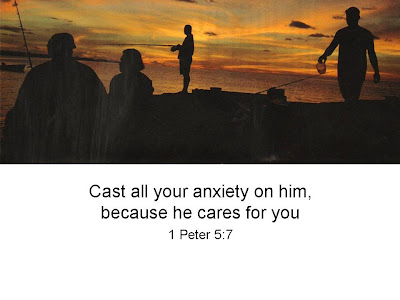
Cast all your anxiety on him because he cares for you

This Sunday we shared in the sacrament of baptism with Tabi. It was a wonderful celebration of the free gift of God's love given by grace to each and everyone of us. It was at the same time a challenge to us all to ask ourselves whether we have made that grace our own by responding to it in faith. What difference does this Christian faith make to us? was the kind of question at the back of our minds as we reflected on 1 Peter 5:7, a verse that one of the senior members of the church shared with 6 year old Tabi.


It’s a bit ironic.

It’s Tabi’s baptism service … but now she’s not with us any more.

That’s actually to miss the point! Tabi and all the children are doing exactly what we are doing – exploring what it means to be followers of Jesus. They are doing it at their level as the Bubbles and Splash groups meet in the second part of our service.

And this baptism service is actually for all of us … it’s not about Tabi. It’s about the difference Jesus can make as he comes into our lives and as we belong to him and we belong to each other.

What difference does our Christian faith make?

First of all, our Christian faith breaks barriers down. We meet together across the age divide and in our church family there are all sorts of different people. It matters to me that the generations mix together – and here at church they do that in quite a unique way. After our Remembrance Sunday service our 102 year old Margaret was at the door with another of our six year olds, Megan. I got them talking to each other. What a remarkable moment. And today, a greeting from Ivy, someone Tabi hasn’t actually met … but who is as much part of our church family as anyone else.

To belong to a church family is to belong to an extended family that breaks down all sorts of barriers. Next week we won’t be here. At 10-00 (note the earlier time!) we shall join with friends from St Luke’s over at St Luke’s. Mixing with another family. That extended family reaches right round the world and brings together people of all races and of all nationalities.

It took time to sink in for Peter. He was steeped in a way of looking at the world that saw it in terms of us and them. His was a world of stark divisions. He didn’t really want to have much to do with the occupying Romans. And then he had a vision. And when the very next day he was invited to the home of Cornelius, a Roman commander, he saw the light.


I could now realise that God treats everyone on the same basis. That’s the remarkable thing about belonging to Jesus and belonging to each other. We are called to be a worshipping people who seek to do what is right and good and make a difference in the world. As we worship and do what is right we are acceptable to him no matter what race we belong to, what background we come from, who we are.

All of this is possible because belonging to Church is all about belonging to Jesus Christ, the Jesus Christ who went everywhere doing good and healing people. God was with Jesus Christ … and our task is to witnesses for him … to share the wonderful good news that through this Jesus we have access to a power beyond ourselves to help us live our lives, and in this Jesus we have a wonderful forgiving love that has the power to renew and strengthen us.

Acts 10:34-43

34 Peter began to speak: “I now realize that it is true that God treats everyone on the same basis.
35 Those who worship him and do what is right are acceptable to him, no matter what race they belong to. 36 You know the message he sent to the people of Israel, proclaiming the Good News of peace through Jesus Christ, who is Lord of all. 37 You know of the great event that took place throughout the land of Israel, beginning in Galilee after John preached his message of baptism. 38 You know about Jesus of Nazareth and how God poured out on him the Holy Spirit and power. He went everywhere, doing good and healing all who were under the power of the Devil, for God was with him. 39 We are witnesses of everything that he did in the land of Israel and in Jerusalem. Then they put him to death by nailing him to a cross. 40 But God raised him from death three days later and caused him to appear, 41 not to everyone, but only to the witnesses that God had already chosen, that is, to us who ate and drank with him after he rose from death. 42 And he commanded us to preach the gospel to the people and to testify that he is the one whom God has appointed judge of the living and the dead. 43 All the prophets spoke about him, saying that all who believe in him will have their sins forgiven through the power of his name.”


I don’t know how you feel. I sometimes feel that the youngsters out there are growing up into a scary world. It’s more than a little un-nerving being a parent today.

I have a sneeking suspicion it has always been the case. When that 102 year old was six the storm clouds were gathering over Europe and the First World War was beginning to loom over the horizon. That was a scary world.

In church we hear each other’s stories. When you listen to all that generation has been through … it’s a scary place, this world of ours. And it always has been so.


It’s special to have that greeting from Ivy today. She’s one of those special people, and there are many of them in our church family and in every church family to go to visit. You might think you do pastoral visiting in order to make other people feel better. The funny thing is that often the opposite happens – you feel all the better yourself!

Ivy is one of those who has drawn on a remarkable strength from her faith in the face of what has been and is a scary world. She has verses she draws on.

One of those verses is in a letter written by Peter when he was a great deal older and in many ways, perhaps wiser. He wrote to Christians everywhere … and his letter very much speaks down through the ages to us in church today.


Make no mistake about it his was a scary world. By the time he wrote this letter a good number of his close friends had been executed in the cruellest of ways simply for following Jesus Christ. He himself, so tradition has it, was to die at the hands of the Romans not long after writing this letter.

And yet, in his older years. He had a very deep and very strong hope. It was a hope that was rooted in Jesus Christ. Peter knew that Jesus had come alongside him in all his suffering and had suffered himself even to the extent on the cross of feeling abandoned by God. That’s pretty severe!

But Peter also knew that Jesus rose again from the dead … and that resurrection released for Peter a very real and very powerful sense of hope. His letter touches on moments of deep suffering. But it is shot through with an indefatigable hope

1 Peter 1:1-5

To God's chosen people who live as refugees scattered throughout the provinces of Pontus, Galatia, Cappadocia, Asia, and Bithynia. 2 You were chosen according to the purpose of God the Father and were made a holy people by his Spirit, to obey Jesus Christ and be purified by his blood.
May grace and peace be yours in full measure.
A Living Hope
3 Let us give thanks to the God and Father of our Lord Jesus Christ! Because of his great mercy he gave us new life by raising Jesus Christ from death. This fills us with a living hope, 4 and so we look forward to possessing the rich blessings that God keeps for his people. He keeps them for you in heaven, where they cannot decay or spoil or fade away. 5 They are for you, who through faith are kept safe by God's power for the salvation which is ready to be revealed at the end of time.


It’s towards the end of that letter that we arrive at the verse that’s so special to Ivy. On Wednesday, as I was preparing for this service, it was the single verse we were invited to read by Josephine Muchelemba who belongs to the church we are partnered with through the Council for World Mission in Zambia.

She was writing in our new CWM book of daily devotion.

I came back to it repeatedly through the day … at our Hy-Way meeting in my visits, not least to Ivy herself in hospital, and as we met together to sift the applications.

It’s a verse that I’ve linked with the greeting from Ivy for Tabi.

It may not be of such importance to her at the moment … but maybe in years to come.

It’s certainly a verse for all of us as parents.

It’s a verse for all of us too.


1 Peter 5:7

Cast all your anxiety on him, because he cares for you.

What a wonderful thought! Anxiety – a state of mind that at times I guess gets the better of most of us.

Cast all your anxiety on him, because he cares for you.

Josephine Muchelemba quotes the verse slightly differently. The difference is not insignificant.

“Cast all your anxieties on him, because he cares for you.”

I guess we each have specific anxieties. As they begin to pile up so that’s what leads to anxiety as a state of mind.

Maybe the way to cast all your anxiety on him, because he cares for you, is to take each of the anxieties that trouble you, in your minds eye one at a time and cast them on him, because he cares for you.

What a wonderful thought.

The prayer Josephine Muchelemba finished her reflection with is not a bad one for us to share as well …

Dear God, help us to put you in control of our lives. Amen.

So much to pass on at Highbury

If you give a little love you can get a little love of your own

A blessing shared at Highbury

Now and the Future at Highbury

Dreaming Dreams Sharing Visions at Highbury

Dreaming Dreams Sharing Visions

Darkness into Light